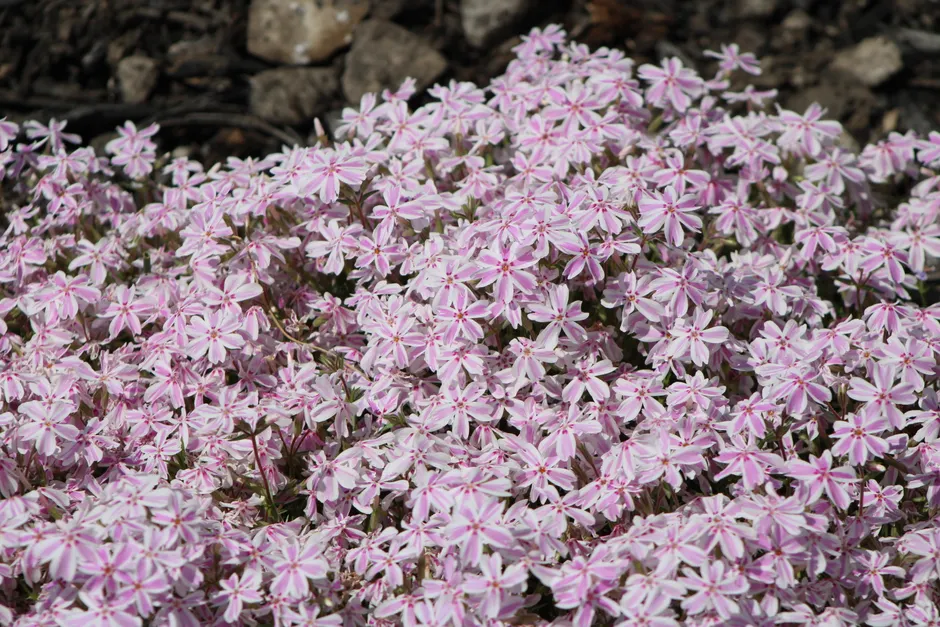
Le Phlox subulata forme un coussin d’environ 20 cm de haut et fleurit souvent de mars à mai, parfois jusqu‘en juin selon la sélection et la météo. Soleil, drainage et arrosage de départ font davantage pour lui qu’un sol détrempé.
Cette vivace couvre-sol produit des tiges légèrement ligneuses, garnies de petites feuilles étroites et pointues. Au printemps, ses fleurs bleues, mauves, blanches ou roses recouvrent presque entièrement le feuillage. Hors floraison, la plante reste discrète, mais elle garde sa place dans une rocaille, au bord d’un massif ou sur le haut d’un muret.
En jardin bio, le phlox peut couvrir une zone minérale sans installer une plante haute devant les autres. Il ne remplace toutefois pas un désherbage de départ. Le liseron, lui, n’a signé aucun traité de paix.
Petit phlox, grand tapis
Photo de Ka’Ron Thompson sur Unsplash.
Le Phlox rampant s’étale progressivement pour former une touffe dense. Une plante adulte atteint souvent une vingtaine de centimètres de hauteur, tandis que certaines sélections couvrent 30 à 40 cm de largeur. La première saison peut sembler maigre, puis le coussin se densifie à partir de la deuxième année.
Les jeunes pousses sont vert tendre avant de foncer au fil de la saison. Après un hiver marqué, les feuilles peuvent rougir ou brunir sous l’effet du gel, puis repartir avec la croissance de mars. Un feuillage abîmé en sortie d’hiver ne signifie donc pas forcément que la plante est perdue. Le massif, lui, peut avoir une allure franchement chiffonnée.
Son port bas convient aux rocailles, aux bordures, aux vasques et au pied de vivaces plus hautes. Sur un muret, les tiges retombent légèrement sur la pierre. Dans un massif, le phlox occupe le premier plan sans masquer les plantes installées derrière.
Soleil en vue, flaques exclues
Photo de Keith Cassill sur Pexels.
Le soleil reste l’exposition la plus favorable. Une mi-ombre lumineuse peut convenir, notamment dans les régions aux étés très chauds, mais une lumière insuffisante réduit la floraison et rend le coussin moins compact. Le bon emplacement compte davantage qu’une promesse de plante increvable.
La terre doit évacuer l’eau rapidement. Le phlox peut pousser dans une terre argileuse si elle est améliorée et ne reste pas gorgée d’eau. Un sol qui garde une humidité modérée sans flaques persistantes convient mieux qu’une terre saturée. Une fois enracinée, la plante tolère de courtes périodes sèches, surtout en pleine terre et dans une rocaille.
L’humidité stagnante fatigue les racines. Dans une zone confinée, l’oïdium peut aussi apparaître, surtout si l’air circule mal ou si la plante subit une situation trop sèche. Commencez par corriger l’emplacement, évitez de mouiller constamment le feuillage et ne serrez pas les plants. Pulvériser au hasard un produit dit naturel, c’est souvent ajouter une couche de mystère à un problème de circulation d’air.
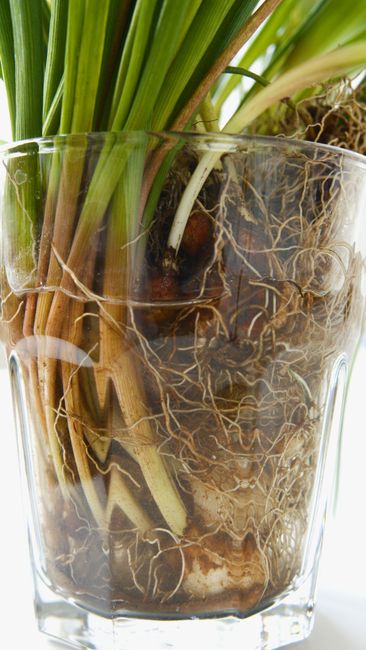
Planter sans se prendre les racines
Photo de Devi Kartika sur Unsplash.
La plantation se réalise au printemps, de mars à avril, ou en automne, d’octobre à décembre, hors période de gel. L’automne laisse davantage de temps aux racines avant les fortes chaleurs. Le printemps permet de suivre facilement la reprise. Dans les deux cas, le drainage passe avant l’esthétique du massif.
Choisissez un emplacement lumineux où l’eau ne s’accumule pas.
Décompactez la terre en surface. En sol lourd, incorporez du compost mûr et améliorez l’évacuation de l’eau.
Installez la motte, comblez autour des racines et tassez légèrement.
Arrosez après la plantation, puis surveillez l’humidité pendant les premières semaines.
Dans un bac, choisissez un contenant large avec des trous de drainage. Une soucoupe pleine d’eau laissée plusieurs jours sous la plante transforme vite une vivace rustique en pensionnaire mécontente.
Le bon emplacement compte davantage qu’un apport massif d’engrais : soleil, drainage et arrosage de départ font l’essentiel du travail.
Quand ça fleurit, ça phloxifie
Photo de TAKAHIRO NISHIZONO sur Unsplash.
La floraison apparaît souvent à partir de la mi-mars dans les climats douxpuis se prolonge en avril et en mai. Certaines sélections restent décoratives jusqu’en juin, tandis qu’un printemps froid retarde le démarrage. Les fleurs légèrement odorantes apparaissent au bout des nouvelles pousses.
Après la floraison, raccourcissez légèrement les tiges défleuries qui dépassent. Cette coupe conserve un port compact et évite de raser la plante jusqu’au sol. Une taille trop sévère supprimerait une partie du coussin au lieu de simplement le remettre en forme.
Au printemps, retirez les feuilles très abîmées par le gel. En automne, déposez un peu de compost mûr en surface sans recouvrir les tiges rampantes. Le sol reste un organisme vivant qu’on nourrit, pas un coffre-fort dans lequel on enfouit tout ce qui traîne dans le tas de compost.
Ça s’étale, ça se multiplie, ça se surveille
Photo de Hanna Pad sur Pexels.
Le coussin fait des petits
Les tiges du Phlox rampant peuvent s’enraciner naturellement au contact de la terre. Ce marcottage permet d’obtenir de nouveaux plants sans semis compliqué. Lorsqu’une tige possède déjà des racines, coupez-la avec un sécateur propre, puis replantez-la en godet ou directement dans une autre zone du jardin.
La division de touffe se pratique au printemps ou en automne. Elle devient utile lorsque le centre se dégarnit ou que la plante perd sa forme compacte, généralement après plusieurs années de culture. Une division tous les trois ou quatre ans peut rajeunir la touffe, à condition de conserver des racines et des pousses sur chaque éclat.
Cette multiplication progressive permet d’étendre une bordure sans acheter de nouveaux plants chaque saison. Il faut toutefois accepter une installation lente. Le phlox rampant n’est pas une moquette déroulée en cinq minutes, et c’est heureux pour les plantes voisines.
Le couvre-sol ne couvre pas les miracles
Photo de Wolfgang Weiser sur Unsplash.
Une fois bien installé, le Phlox rampant réduit la surface de terre nue, mais il ne supprime pas toutes les herbes concurrentes. Les adventices qui s’installent avant lui peuvent traverser le coussin ou réapparaître entre les tiges. Un désherbage soigneux avant la plantation reste donc plus efficace que l’espoir de voir le phlox régler seul le dossier du liseron.
La plante montre aussi ses limites en terre détrempée, en ombre dense et dans les pots mal drainés. À l’inverse, une rocaille ensoleillée, un talus léger ou le sommet d’un muret lui conviennent mieux. La tolérance à la sécheresse concerne surtout une plante déjà enracinée : un jeune sujet planté en plein été ne possède pas encore ce confort.
Le Phlox rampant fleurit tôt, reste bas et se multiplie par marcottage lorsque ses tiges touchent la terre. Il demande surtout qu’on respecte ses racines. Après cela, il peut couvrir la pierre et border le massif. La météo, elle, garde toujours le dernier mot.
Sources et références scientifiques
Environmental factors affecting RNAi efficacy: Temperature but not plant cultivar influences Colorado potato beetle's response to insecticidal dsRNA – PMC. Insect molecular biology. DOI: 10.1111/imb.12996 · PMID: 40410128.
Alyokhin, A., Baker, M., Mota‐Sanchez, D., Dively, G. & Grafius, E. (2008) Colorado potato beetle resistance to insecticides. American Journal of Potato Research, 85, 395-413. [Google Scholar].
Bachman, P., Fischer, J., Song, Z.H., Urbanczyk‐Wochniak, E. & Watson, G. (2020) Environmental fate and dissipation of applied dsRNA in soil, aquatic systems, and plants. Frontiers in Plant Science, 11, 21. [DOI] [PMC free article] [PubMed] [Google Scholar].
Ballard, J., Ellis, D.J. & Payne, C.C. (2000) The role of formulation additives in increasing the potency of Cydia pomonella granulovirus for codling moth larvae, in laboratory and field experiments. Biocontrol Science and Technology, 10, 627-640. [Google Scholar].
Bates, D., Mächler, M., Bolker, B. & Walker, S. (2015) Fitting linear mixed‐effects models using lme4. Journal of Statistical Software, 67, 1-48. [Google Scholar].
Baum, J.A. & Roberts, J.K. (2014) Chapter five – progress towards RNAi‐mediated insect pest management. In: Tarlochan, S.D. & Sarjeet, S.G. (Eds.) Advances in insect physiology. London, UK: Academic Press, pp. 249-295. [Google Scholar].
Cappelle, K., de Oliveira, C.F., Van Eynde, B., Christiaens, O. & Smagghe, G. (2016) The involvement of clathrin‐mediated endocytosis and two Sid‐1‐like transmembrane proteins in double‐stranded RNA uptake in the Colorado potato beetle midgut. Insect Molecular Biology, 25(3), 315-323. [DOI] [PubMed] [Google Scholar].
Carmell, M.A., Xuan, Z., Zhang, M.Q. & Hannon, G.J. (2002) The argonaute family: tentacles that reach into RNAi, developmental control, stem cell maintenance, and tumorigenesis. Genes and Development, 16, 2733-2742. [DOI] [PubMed] [Google Scholar].
Cedden, D., Güney, G., Debaisieux, X., Scholten, S., Rostás, M. & Bucher, G. (2025) Effective target genes for RNA interference‐based management of the cabbage stem flea beetle. Insect Molecular Biology, 34, 527-539. Available from: 10.1111/imb.12942 [DOI] [PMC free article] [PubMed] [Google Scholar]. doi:10.1111/imb.12942.
Chen, J., Peng, Y., Zhang, H., Wang, K., Tang, Y., Gao, J. et al. (2021) Transcript level is a key factor affecting RNAi efficiency. Pesticide Biochemistry and Physiology, 176, 104872. [DOI] [PubMed] [Google Scholar].
Chen, X., Tan, A. & Palli, S.R. (2020) Identification and functional analysis of promoters of heat‐shock genes from the fall armyworm, Spodoptera frugiperda. Scientific Reports, 10, 2363. [DOI] [PMC free article] [PubMed] [Google Scholar].
Christiaens, O., Swevers, L. & Smagghe, G. (2014) DsRNA degradation in the pea aphid (Acyrthosiphon pisum) associated with lack of response in RNAi feeding and injection assay. Peptides, 53, 307-314. [DOI] [PubMed] [Google Scholar].
Targeted mutagenesis of FATTY ACID ELONGASE 1 entails near complete elimination of very long chain fatty acids in the seeds of camelina cultivar Ligena – PMC. aBIOTECH. DOI: 10.1007/s42994-025-00238-z · PMID: 41312102.
Abe F, Haque E, Hisano H et al (2019) Genome-edited triple-recessive mutation alters seed dormancy in wheat. Cell Rep 28(5):1362-1369. 10.1016/j.celrep.2019.06.090 [DOI] [PubMed] [Google Scholar]. doi:10.1016/j.celrep.2019.06.090.
Aznar-Moreno J, Durrett T (2017) Simultaneous targeting of multiple gene homeologs to alter seed oil production in Camelina sativa. Plant Cell Physiol 58(7):1260-1267. 10.1093/pcp/pcx058 [DOI] [PubMed] [Google Scholar]. doi:10.1093/pcp/pcx058.
Bryant FM, Munoz-Azcarate O, Kelly AA, Beaudoin F, Kurup S, Eastmond PJ (2016) ACYL-ACYL CARRIER PROTEIN DESATURASE2 and 3 are responsible for making omega-7 fatty acids in the Arabidopsis aleurone. Plant Physiol 172(1):154-162. 10.1104/pp.16.00836 [DOI] [PMC free article] [PubMed] [Google Scholar]. doi:10.1104/pp.16.00836.
Čermák T, Baltes NJ, Čegan R, Zhang Y, Voytas DF (2015) High-frequency, precise modification of the tomato genome. Genome Biol 16:1-15. 10.1186/s13059-015-0796-9 [DOI] [PMC free article] [PubMed] [Google Scholar]. doi:10.1186/s13059-015-0796-9.
Chien K, Bellary A, Nicar M, Mukherjee A, Buja L (1983) Induction of a reversible cardiac lipidosis by a dietary long-chain fatty acid (erucic acid). Relationship to lipid accumulation in border zones of myocardial infarcts. The Am J Pathol 112(1):68. [PMC free article] [PubMed] [Google Scholar].
Doench JG, Fusi N, Sullender M et al (2016) Optimized sgRNA design to maximize activity and minimize off-target effects of CRISPR-Cas9. Nat Biotechnol 34(2):184-191. 10.1038/nbt.3437 [DOI] [PMC free article] [PubMed] [Google Scholar]. doi:10.1038/nbt.3437.
Fiebig A, Mayfield JA, Miley NL, Chau S, Fischer RL, Preuss D (2000) Alterations in CER6, a gene identical to CUT1, differentially affect long-chain lipid content on the surface of pollen and stems. Plant Cell 12(10):2001-2008. 10.1105/tpc.12.10.2001 [DOI] [PMC free article] [PubMed] [Google Scholar]. doi:10.1105/tpc.12.10.2001.
Gao J, Wang G, Ma S et al (2015) CRISPR/Cas9-mediated targeted mutagenesis in Nicotiana tabacum. Plant Mol Biol 87:99-110. 10.1007/s11103-014-0263-0 [DOI] [PubMed] [Google Scholar]. doi:10.1007/s11103-014-0263-0.
Ghidoli M, Ponzoni E, Araniti F, Miglio D, Pilu R (2023) Genetic improvement of Camelina sativa (L.) Crantz: opportunities and challenges. Plants 12(3):570. 10.3390/plants12030570 [DOI] [PMC free article] [PubMed] [Google Scholar]. doi:10.3390/plants12030570.
Gruber AR, Lorenz R, Bernhart SH, Neuböck R, Hofacker IL (2008) The vienna RNA websuite. Nucl Acids Res 36 (suppl_2):W70-W74. 10.1093/nar/gkn188 [DOI] [PMC free article] [PubMed] [Google Scholar]. doi:10.1093/nar/gkn188.
Hoffie RE, Otto I, Perovic D et al (2021) Targeted knockout of eukaryotic translation initiation factor 4E confers bymovirus resistance in winter barley. Front Genom Edit 3:784233. 10.3389/fgeed.2021.784233 [DOI] [PMC free article] [PubMed] [Google Scholar]. doi:10.3389/fgeed.2021.784233.
Hoffie IVO (2022) Entwicklung des modularen CasCADE-Vektorsystems und dessen Verwendung zur gezielten Mutagenese der Stp13-Orthologe von Weizen und Gerste für die Etablierung dauerhafter Resistenz gegen Rost-und Mehltaupilze. 10.15488/13200. doi:10.15488/13200.
Analysis of Unique Flavor Metabolites and Seasonal Variations of the Special Tea Plant Cultivar of Fuliang Tea, a Geographical Indication Product – PMC. Plants (Basel, Switzerland). DOI: 10.3390/plants15111635 · PMID: 42280672.
1.Miyake Y., Kohsaka R. Discourse of quality and place in geographical indications: Applying convention theory to Japanese tea. Food Rev. Int. 2023;39:4610-4635. doi: 10.1080/87559129.2022.2029882. [DOI] [Google Scholar]. doi:10.1080/87559129.2022.2029882.
2.Zhu F.X. The gift of 30° north latitude, the thousand-year-old Fuliang tea. Agric. Prod. Mark. 2022;11:20-25. [Google Scholar].
en L.E., Rao L.F. Jiangxi Fuliang tea: A thousand-year journey through mountains and seas with a cup of spring tea. Agric. Prod. Mark. 2025;9:41-43. [Google Scholar].
4.Wang Z.H., Yang P.X., Peng H., Li W.J., Yue C.N., Wang S.L., BAo R.Y., Jiang X.F. A new tea cultivar‘Fuliang Zhuye 1’. Acta Hortic. Sin. 2022;49:191-192. [Google Scholar].
5.Li Y.F., Han Z., Wang M., Yan Y.X., Ma R.H., Wang H.P., Deng W.W. Metabolomics and sensory evaluation reveal the influence of four albino tea cultivars on the quality of processed green tea. Food Res. Int. 2025;209:116180. doi: 10.1016/j.foodres.2025.116180. [DOI] [PubMed] [Google Scholar]. doi:10.1016/j.foodres.2025.116180.
en L., Shi Y.X., Sun J.Y., Wang H.J., Wang Y.F., Shu Z.J., He W.Z., Dong C.W., Xu P. Deciphering the flavor profile and seasonal variation of black tea processed from cultivar ‘baiye 1’. Food Res. Int. 2025;208:116181. doi: 10.1016/j.foodres.2025.116181. [DOI] [PubMed] [Google Scholar]. doi:10.1016/j.foodres.2025.116181.
7.Zhang L., Cao Q.Q., Geanato D., Xu R.Q., Ho C.T. Association between chemistry and taste of tea: A review. Trends Food Sci. Technol. 2020;101:139-149. doi: 10.1016/j.tifs.2020.05.015. [DOI] [Google Scholar]. doi:10.1016/j.tifs.2020.05.015.
8.Ye J.H., Ye Y., Yin J.F., Jin J., Liang Y.R., Liu R.Y., Tang P., Xu Y.Q. Bitterness and astringency of tea leaves and products: Formation mechanism and reducing strategies. Trends Food Sci. Technol. 2022;123:130-143. doi: 10.1016/j.tifs.2022.02.031. [DOI] [Google Scholar]. doi:10.1016/j.tifs.2022.02.031.
9.Yan K.N., Wang J.T., Zhou M.X., Peng Q.H., Mahmoud A.B., Bai X., Baldermann S., Jiang X.B., Feng S., Wu Y., et al. Insights into potential flavor-active peptides and taste-related compounds in longjing teas: A comparative study of ‘longjing 43’ and ‘qunti’ cultivars. Food Chem. 2025;471:142790. doi: 10.1016/j.foodchem.2025.142790. [DOI] [PubMed] [Google Scholar]. doi:10.1016/j.foodchem.2025.142790.
en D., Sun Z., Gao J.J., Peng J.K., Wang Z., Zhao Y.N., Lin Z., Dai W.D. Metabolomics combined with proteomics provides a novel interpretation of the compound differences among Chinese tea cultivars (Camellia sinensis var. sinensis) with different manufacturing suitabilities. Food Chem. 2022;377:131976. doi: 10.1016/j.foodchem.2021.131976. [DOI] [PubMed] [Google Scholar]. doi:10.1016/j.foodchem.2021.131976.
11.Feng W.Z., Zhou H., Xiong Z.C., Sheng C.Y., Xia D.Z., Zhang J.X., Li T.H., Wei Y.M., Deng W.W., Ning J.M. Exploring the effect of different tea varieties on the quality of lu’an guapian tea based on metabolomics and molecular sensory science. Food Chem. X. 2024;23:101534. doi: 10.1016/j.fochx.2024.101534. [DOI] [PMC free article] [PubMed] [Google Scholar]. doi:10.1016/j.fochx.2024.101534.
12.Zheng Y.C., Hu Q.C., Wu Z.J., Bai W.J., Chen B., Hao Z.L., Wu L.Y., Ye N.X., Sun Y. Recent advances in metabolomics and flavoromics have enabled the systematic dissection of cultivar-specific flavor signatures. LWT-Food Sci. Technol. 2022;164:113666. doi: 10.1016/j.lwt.2022.113666. [DOI] [Google Scholar]. doi:10.1016/j.lwt.2022.113666.
Identification of intraspecific cultivar Melia azedarach ‘Mizhi’ based on complete chloroplast genome data and leaf anatomy – PMC. Frontiers in plant science. DOI: 10.3389/fpls.2026.1783041 · PMID: 41907722.
Akinyele A. O., Fabowale A. G., Onefeli A. O. (2021). Comparative morphology of the leaf epidermis in four species of Meliaceae L. Family. Environ. Sci. Proc. 3, 73. doi: 10.3390/IECF2020-08032, PMID: 41725453 [DOI] [Google Scholar]. doi:10.3390/IECF2020-08032.
Albach D. C., Tsymbalyuk Z. M., Mosyakin S. L. (2021). Pollen morphology of Ellisiophyllum and Sibthorpia (Plantaginaceae, tribe Sibthorpieae) and phylogenetics of the tribe. Plant Systematics Evol. 307, 66. doi: 10.1007/s00606-021-01786-9, PMID: 41800275 [DOI] [Google Scholar]. doi:10.1007/s00606-021-01786-9.
Álvarez I., Wendel J. F. (2003). Ribosomal ITS sequences and plant phylogenetic inference. Mol. Phylogenet. Evol. 29, 417-434. doi: 10.1016/S1055-7903(03)00208-2, PMID: [DOI] [PubMed] [Google Scholar]. doi:10.1016/S1055-7903(03)00208-2.
Amiryousefi A., Hyvönen J., Poczai P. (2018). IRscope: an online program to visualize the junction sites of chloroplast genomes. Bioinformatics 34, 3030-3031. doi: 10.1093/bioinformatics/bty220, PMID: [DOI] [PubMed] [Google Scholar]. doi:10.1093/bioinformatics/bty220.
Azizi M. M. F., Lau H. Y., Abu-Bakar N. (2021). Integration of advanced technologies for plant variety and cultivar identification. J. Biosci. 46, 91. doi: 10.1007/s12038-021-00214-x, PMID: [DOI] [PubMed] [Google Scholar]. doi:10.1007/s12038-021-00214-x.
Bai X., Jiang S., Li P., Shi S., Zhang X., Zhao J., et al. (2024). A new Melia cultivar ‘Zijinlian’. Acta Hortic. Sin. 51, 219-220. doi: 10.16420/j.issn.0513-353x.2023-0896 [DOI] [Google Scholar]. doi:10.16420/j.issn.0513-353x.2023-0896.
Capella-Gutiérrez S., Silla-Martínez J. M., Gabaldón T. (2009). TrimAl: a tool for automated alignment trimming in large-scale phylogenetic analyses. Bioinformatics 25, 1972-1973. doi: 10.1093/bioinformatics/btp348, PMID: [DOI] [PMC free article] [PubMed] [Google Scholar]. doi:10.1093/bioinformatics/btp348.
Chen L., Deng X., Ding M., Liu M., Li J., Hui W., et al. (2014). Geographic variation in traits of fruit stones and seeds of Melia azedarach. J. Beijing Forestry Univ. 36, 15-20. doi: 10.5555/20143196227, PMID: 41544026 [DOI] [Google Scholar]. doi:10.5555/20143196227.
Cho K.-S., Kwon M., Cho J.-H., Im J.-S., Park Y.-E., Hong S.-Y., et al. (2017). Characterization of trichome morphology and aphid resistance in cultivated and wild species of potato. Horticulture Environment Biotechnol. 58, 450-457. doi: 10.1007/s13580-017-0078-4, PMID: 41800275 [DOI] [Google Scholar]. doi:10.1007/s13580-017-0078-4.
Civetta A. (2003). Positive selection within sperm-egg adhesion domains of Fertilin: An ADAM gene with a potential role in fertilization. Mol. Biol. Evol. 20, 21-29. doi: 10.1093/molbev/msg002, PMID: [DOI] [PubMed] [Google Scholar]. doi:10.1093/molbev/msg002.
Feng S., Liu Z., Hu Y., Tian J., Yang T., Wei A. (2020). Genomic analysis reveals the genetic diversity, population structure, evolutionary history and relationships of Chinese pepper. Horticulture Res. 7, 158. doi: 10.1038/s41438-020-00376-z, PMID: [DOI] [PMC free article] [PubMed] [Google Scholar]. doi:10.1038/s41438-020-00376-z.
Bruno Nunez. Le Phlox rampant: un couvre-sol lumineux. 2017.
Phlox rampant Blue Ridge, couvre-sol bleu facile | Willemse.
Eric est jardinier passionné depuis 22 ans. Il partage régulièrement ses conseils et astuces de jardinage sur son blog "Jardin-Bio", pour aider les débutants comme les jardiniers confirmés à entretenir et faire évoluer leur jardin.