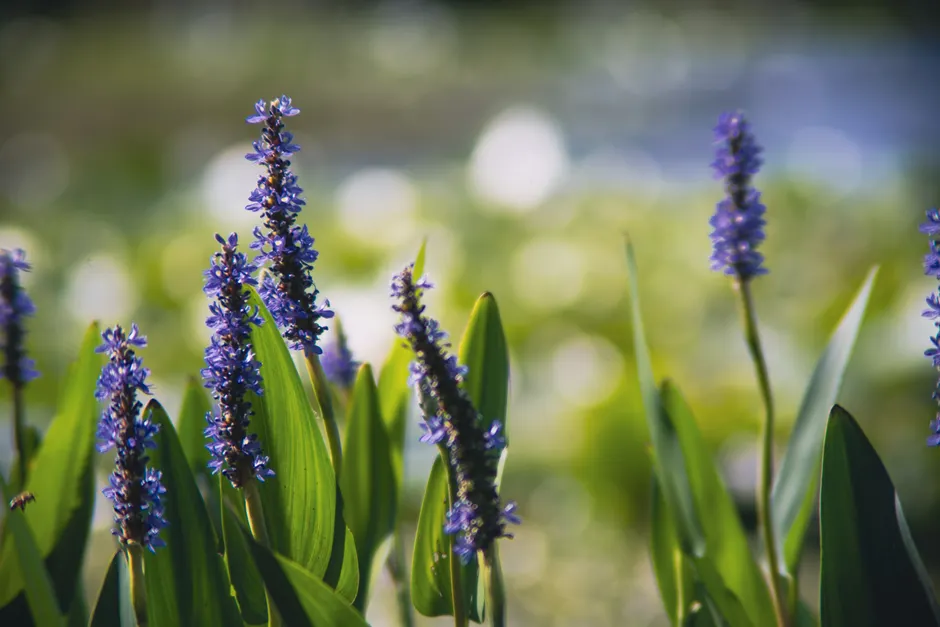
La pontédérie à feuilles en cœur, Pontederia cordatafleurit de juin à août dans une eau peu profonde. Ses épis bleus sont faciles à apprécier, ses rhizomes un peu moins faciles à laisser courir.
Originaire des Amériques, cette vivace aquatique forme une touffe de feuilles vertes, lancéolées et cordées à la base. Elle atteint environ 45 à 70 cm de hauteur et s’étale sur 60 cm à 1 m selon les conditions. Les fleurs bleues à bleu lavande apparaissent au-dessus du feuillage, sur des tiges qui émergent nettement de l’eau.
La plante convient à une berge calme, à un bassin d’ornement ou à un grand pot. Elle préfère le soleil ou la mi-ombre, un substrat riche et argileux, ainsi qu’une faible immersion. Le point à prévoir avant la plantation, c’est la maîtrise de la souche et de ses rhizomes.
Cœur à l’eau, racines dans la vase

La plantation se fait au printemps, lorsque la reprise végétative n’est plus exposée à un froid prolongé. Les indications horticoles placent la pontédérie dans une eau peu profonde, souvent entre 15 et 40 cm. Elle peut aussi pousser directement en terre humide ou dans un contenant installé au bord du bassin.
Le substrat doit rester consistant et argileux. Un support trop léger se disperse plus facilement dans l’eau, tandis qu’une terre riche tient mieux autour de la souche. Installez la plante dans une eau calme, au soleil ou à mi-ombre. Une exposition lumineuse soutient la floraison, mais une ombre légère peut réduire le dessèchement d’un bac peu profond en été.
Panier bien tenu, bassin tranquille
Un panier ou un pot facilite le suivi de la touffe et la mise à l’abri lorsque le gel menace. La culture en contenant limite aussi la dispersion des fragments de rhizome. En pleine terrela plante dispose de davantage de place pour s’étendre et devient plus difficile à déplacer proprement.
La pontédérie pousse vite dans de bonnes conditions. C’est agréable au début, puis ça peut devenir une sacrée cliente quand chaque morceau de souche retrouve un peu de vase. On gagne donc à prévoir ses limites avant de remplir le bassin, pas après.
Rhizome en roue libre, bassin en garde
La multiplication végétative est le vrai sujet de surveillance. Dans une touffe installée, les rhizomes peuvent produire de nouvelles pousses. Lorsqu’on divise la plante, chaque fragment doit rester dans un bassin ou un contenant maîtrisé.
Une étude publiée en 2022 dans Ecology and Evolution a examiné la reproduction de Pontederia cordata en Afrique du Sud. Les chercheurs ont étudié les formes florales, les visites d’insectes et la pollinisation manuelle de 8 865 fleurs. Dans les populations observées, seules des plantes portant la forme florale courte étaient présentes et aucune graine n’a été produite.
Ce résultat concerne ces populations sud-africaines. Il ne signifie pas que l’espèce est partout incapable de produire des graines. Il montre en revanche que la propagation végétative peut suffire à maintenir une population lorsque la reproduction sexuée ne fonctionne pas. L’absence de graines dans un cas précis ne rend donc pas les rhizomes inoffensifs.
Chez Jardin-Bio, on préfère contenir la pontédérie dès le départ plutôt que courir après les rejets trois ans plus tard. Le voisin aura toujours une théorie contradictoire sur la vitesse de croissance, mais le rhizome, lui, ne débat pas.
Juin fait le show, l’hiver tient la caisse

Avril rabat, juin sort les épis
Dans les régions au climat doux, la touffe peut rester en place. Au début du printemps, retirez les feuilles sèches et les parties abîmées pour dégager les nouvelles pousses. Une division de la touffe permet de contrôler son volume, à condition de récupérer les fragments et de les replanter dans un espace prévu pour eux.
La floraison intervient habituellement de juin à août. Les épis fanés peuvent être retirés pour garder une touffe nette, mais ce geste ne garantit pas une nouvelle floraison. La lumière, la température de l’eau et la vigueur de la souche restent déterminantes.
Hiver en pot, souche au chaud
Dans les secteurs froids, la culture en pot facilite la mise à l’abri. Le contenant peut être retiré de la zone exposée au gel et conservé dans un endroit protégé pendant l’hiver. Lorsque la plante reste au bassin, une profondeur suffisante aide à maintenir la souche hors gel, mais cette protection dépend du climat et de la configuration du bassin.
Le calendrier est donc simple, sans être automatique : plantation au printemps, surveillance des rhizomes, nettoyage au redémarrage et protection de la souche si le gel menace. La météo, comme toujours, adore déplacer les dates au dernier moment.
Épuration : l’eau ne boit pas les promesses

La pontédérie est parfois présentée comme une plante de phytoépuration. Ses racines peuvent être associées à des microorganismes, mais cette observation ne suffit pas à transformer une plante ornementale en dispositif de traitement.
Une étude publiée en 1998 dans Applied and Environmental Microbiology a caractérisé des bactéries méthanotrophes associées aux racines de trois macrophytes d’eau douce, dont Pontederia cordata. Les chercheurs ont identifié au moins sept taxons distincts dans des cultures enrichies. L’étude portait sur l’association entre les racines et ces bactéries, pas sur la capacité d’une pontédérie installée dans un bassin de jardin à traiter une pollution.
Une autre étude, publiée en 2025 dans Plantsa observé la réponse de la pontédérie au cadmium en culture hydroponique. À 0,1 mM de cadmium, les plantes testées ont conservé une croissance et une structure des chloroplastes normales dans les conditions de l’expérience. Entre 0,2 et 0,4 mM, les chercheurs ont relevé des perturbations des chloroplastes, une baisse de la chlorophylle et une diminution des performances photosynthétiques.
Le bassin reste un système vivant, pas une cuve magique. La pontédérie peut participer au décor d’une zone humide bien gérée, mais elle ne remplace pas un dispositif conçu pour mesurer et réduire une pollution.
Du violet au blanc, les gènes font leur numéro

La couleur des fleurs ne dépend pas uniquement de l’exposition ou de la fertilité du substrat. Une étude publiée en 2025 dans DNA Research a présenté le premier assemblage génomique de Pontederia cordata au niveau chromosomique : 527,5 millions de bases, huit pseudochromosomes et 29 389 gènes codant des protéines.
Les chercheurs ont aussi comparé des fleurs violettes et blanches. La baisse d’expression de plusieurs gènes de la voie des anthocyanes, notamment F3’5’HDFRANS et UFGTa été associée au passage du violet au blanc. Une pontédérie blanche n’est donc pas simplement une plante bleue qui manque de soleil.
Pour le jardinier, la décision reste terre à terre : choisir une eau peu profonde et calme, installer la souche dans un substrat consistant, contenir les rhizomes et anticiper l’hiver. Avec ce cadre, les épis bleus restent du côté du plaisir. Sans lui, le bassin risque surtout de fournir un nouveau feuilleton aux limaces, au voisin et à la météo.
Sources et références scientifiques
- Characterization of Root-Associated Methanotrophs from Three Freshwater Macrophytes: Pontederia cordata, Sparganium eurycarpum, and Sagittaria latifolia – PMC. Applied and environmental microbiology. DOI: 10.1128/aem.64.3.1099-1105.1998 · PMID: 16349515.
- 1.Amaral J A, Knowles R. Growth of methanotrophs in methane and oxygen counter gradients. FEMS Microbiol Lett. 1995;126:215-220. [Google Scholar].
- 2.Ausubel F M, Brent R, Kingston R E, Moore D D, Seidman J G, Smith J A, Struhl K. Short protocols in molecular biology. 2nd ed. New York, N.Y: John Wiley and Sons; 1992. [Google Scholar].
- 3.Bédard C, Knowles R. Physiology, biochemistry and specific inhibitors of CH4, NH4+, and CO oxidation by methanotrophs and nitrifiers. Microbiol Rev. 1989;53:68-84. doi: 10.1128/mr.53.1.68-84.1989. [DOI] [PMC free article] [PubMed] [Google Scholar]. doi:10.1128/mr.53.1.68-84.1989.
- 4.Bowman J P, Sly L I, Cox J M, Hayward A C. Methylomonas fodinarum sp. nov. and Methylomonas aurantiaca sp. nov.: two closely related type I obligate methanotrophs. Syst Appl Microbiol. 1990;13:279-287. [Google Scholar].
- 5.Bowman J P, Sly L I, Nichols P D, Hayward A C. Revised taxonomy of the methanotrophs: description of Methylobacter gen. nov., emendation of Methylococcus, validation of Methylosinus and Methylocystis species, and a proposal that the family Methylococcaceae includes only the group I methanotrophs. Int J Syst Bacteriol. 1993;43:735-753. [Google Scholar].
- 6.Brusseau G A, Tsien H C, Hanson R S, Wackett L P. Optimization of trichloroethylene oxidation by methanotrophs and the use of a colorimetric assay to detect soluble methane monooxygenase activity. Biodegradation. 1990;1:19-29. doi: 10.1007/BF00117048. [DOI] [PubMed] [Google Scholar]. doi:10.1007/BF00117048.
- 7.Brusseau G A, Bulygina E S, Hanson R S. Phylogenetic analysis and development of probes for differentiating methylotrophic bacteria. Appl Environ Microbiol. 1994;60:626-636. doi: 10.1128/aem.60.2.626-636.1994. [DOI] [PMC free article] [PubMed] [Google Scholar]. doi:10.1128/aem.60.2.626-636.1994.
- 8.Buchholz L A, Klump J V, Collins M L P, Brantner C A, Remsen C C. Activity of methanotrophic bacteria in Green-Bay sediments. FEMS Microbiol Ecol. 1995;16:1-8. [Google Scholar].
- lhoun A, King G M. Regulation of root-associated methanotrophy by oxygen availability in the rhizosphere of two aquatic macrophytes. Appl Environ Microbiol. 1997;63:3051-3058. doi: 10.1128/aem.63.8.3051-3058.1997. [DOI] [PMC free article] [PubMed] [Google Scholar]. doi:10.1128/aem.63.8.3051-3058.1997.
- vanaugh C M. Symbiosis of chemoautotrophic bacteria and marine invertebrates from hydrothermal vents and reducing sediments. Bull Biol Soc Wash. 1985;6:373-388. [Google Scholar].
- ildress J J, Fischer C R, Brooks J M, Kennicut M C, Bidigare R, Anderson A E. A methanotrophic marine molluscan (Bivalvia: Mytilidae) symbiosis: mussels fueled by gas. Science. 1986;233:1306-1308. doi: 10.1126/science.233.4770.1306. [DOI] [PubMed] [Google Scholar]. doi:10.1126/science.233.4770.1306.
- 12.Felsenstein J. Phylogenies from molecular sequences: inferences and reliability. Annu Rev Genet. 1988;22:521-565. doi: 10.1146/annurev.ge.22.120188.002513. [DOI] [PubMed] [Google Scholar]. doi:10.1146/annurev.ge.22.120188.002513.
- Photosynthetic Responses of Pontederia cordata to Cadmium Stress: Anatomical Structure, Ultrastructure, Physiology, and Gene Expression – PMC. Plants (Basel, Switzerland). DOI: 10.3390/plants14091344 · PMID: 40364373.
- 1.El Rasafi T., Oukarroum A., Haddioui A., Song H., Kwon E.E., Bolan N., Tack F.M., Sebastian A., Prasad M.N.V., Rinklebe J. Cadmium stress in plants: A critical review of the effects, mechanisms, and tolerance strategies. Crit. Rev. Environ. Sci. Technol. 2022;52:675-726. doi: 10.1080/10643389.2020.1835435. [DOI] [Google Scholar]. doi:10.1080/10643389.2020.1835435.
- 2.Rizwan M., Ali S., Adrees M., Ibrahim M., Tsang D.C., Zia-Ur-Rehman M., Zahir Z.A., Rinklebe J., Tack F.M., Ok Y.S. A critical review on effects, tolerance mechanisms and management of cadmium in vegetables. Chemosphere. 2017;182:90-105. doi: 10.1016/emosphere.2017.05.013. [DOI] [PubMed] [Google Scholar]. doi:10.1016/j.chemosphere.2017.05.013.
- 3.Dobrikova A., Apostolova E., Hanć A., Yotsova E., Borisova P., Sperdouli I., Adamakis I.-D.S., Moustakas M. Cadmium toxicity in Salvia sclarea L.: An integrative response of element uptake, oxidative stress markers, leaf structure and photosynthesis. Ecotoxicol. Environ. Saf. 2021;209:11851. doi: 10.1016/j.ecoenv.2020.111851. [DOI] [PubMed] [Google Scholar]. doi:10.1016/j.ecoenv.2020.111851.
- 4.Zhang Q., Chen Y., Li Z., Tan X.-T., Xin G.-R., He C.-T. Defense guard: Strategies of plants in the fight against cadmium stress. Adv. Biotechnol. 2024;2:44. doi: 10.1007/s44307-024-00052-6. [DOI] [PMC free article] [PubMed] [Google Scholar]. doi:10.1007/s44307-024-00052-6.
- 5.Liang A., Ma C., Xiao J., Hao Y., Li H., Guo Y., Cao Y., Jia W., Han L., Chen G., et al. Micro/nanoscale bone char alleviates cadmium toxicity and boosts rice growth via positively altering the rhizosphere and endophytic microbial community. J. Hazard. Mater. 2023;454:131491. doi: 10.1016/j.jhazmat.2023.131491. [DOI] [PubMed] [Google Scholar]. doi:10.1016/j.jhazmat.2023.131491.
- 6.Lysenko E., Klaus A., Kartashov A., Kusnetsov V.V. Specificity of Cd, Cu, and Fe effects on barley growth, metal contents in leaves and chloroplasts, and activities of photosystem I and photosystem II. Plant Physiol. Biochem. 2020;147:191-204. doi: 10.1016/j.plaphy.2019.12.006. [DOI] [PubMed] [Google Scholar]. doi:10.1016/j.plaphy.2019.12.006.
- 7.Waheed A., Zhang Q., Xu H., Dou H., Muhammad M., Aili A., O Alshaharni M. Mitigation of cadmium stress by salicylic acid: Physiological and biochemical responses in NM-2006, NM-92, and Mash-88 mung bean varieties. J. Hazard. Mater. 2025;485:136878. doi: 10.1016/j.jhazmat.2024.136878. [DOI] [PubMed] [Google Scholar]. doi:10.1016/j.jhazmat.2024.136878.
- rmosilva E., Scales J., Madgwick P., Parry M.A.J. Optimizing rubisco and its regulation for greater resource use efficiency. Plant Cell Environ. 2015;38:1817. doi: 10.1111/pce.12425. [DOI] [PubMed] [Google Scholar]. doi:10.1111/pce.12425.
- 9.Sarabi B., Fresneau C., Ghaderi N., Bolandnazar S., Streb P., Badeck F.-W., Citerne S., Tangama M., David A., Ghashghaie J. Stomatal and non-stomatal limitations are responsible in down-regulation of photosynthesis in melon plants grown under the saline condition: Application of carbon isotope discrimination as a reliable proxy. Plant Physiol. Biochem. 2019;141:1-19. doi: 10.1016/j.plaphy.2019.05.010. [DOI] [PubMed] [Google Scholar]. doi:10.1016/j.plaphy.2019.05.010.
- 10.Yu Z., Huang X., Xiang J., Qin X., Xiang L., Zou X., Zhu F. PSI-mediated NADPH production and enzyme regulation play critical roles in carbon assimilation of pepper seedlings under cadmium stress. Hortic. Plant J. 2025 in press. [Google Scholar].
- 11.Croce R., Carmo-Silva E., Cho Y.B., Ermakova M., Harbinson J., Lawson T., McCormick A.J., Niyogi K.K., Ort D.R., Patel-Tupper D., et al. Perspectives on improving photosynthesis to increase crop yield. Plant Cell. 2024;36:3944-3973. doi: 10.1093/plcell/koae132. [DOI] [PMC free article] [PubMed] [Google Scholar]. doi:10.1093/plcell/koae132.
- 12.Siddiqui M., Mukherjee S., Kumar R., Alansi S., Shah A.A., Kalaji H.M., Javed T., Raza A. Potassium and melatonin-mediated regulation of fructose-1,6-bisphosphatase (FBPase) and sedoheptulose-1,7-bisphosphatase (SBPase) activity improve photosynthetic efficiency, carbon assimilation and modulate glyoxalase system accompanying tolerance to cadmium stress in tomato seedlings. Plant Physiol. Biochem. 2022;171:49-65. doi: 10.1016/j.plaphy.2021.12.018. [DOI] [PubMed] [Google Scholar]. doi:10.1016/j.plaphy.2021.12.018.
- Chromosome-level genome assembly of Pontederia cordata L. provides insights into its rapid adaptation and variation of flower colours – PMC. DNA research : an international journal for rapid publication of reports on genes and genomes. DOI: 10.1093/dnares/dsaf002 · PMID: 39878035.
- 1. Xin J, et al. Pontederia cordata, an ornamental aquatic macrophyte with great potential in phytoremediation of heavy-metal-contaminated wetlands. Ecotoxicol Environ Saf. 2020:203:111024. 10.1016/j.ecoenv.2020.111024 [DOI] [PubMed] [Google Scholar]. doi:10.1016/j.ecoenv.2020.111024.
- 2. Wansell SNL, Geerts S, Coetzee JA.. Where are the seeds? Lack of floral morphs prevent seed production by the tristylous Pontederia cordata in South Africa. Ecol Evol. 2022:12:e9366. 10.1002/ece3.9366 [DOI] [PMC free article] [PubMed] [Google Scholar]. doi:10.1002/ece3.9366.
- 3. Dana ED, García-de-Lomas J, Verloove F.. First record of Pontederia cordata L. (Pontederiaceae) in southern Spain and risk assessment for Europe. Bioinvasions Rec. 2021:10:775-788. [Google Scholar].
- 4. Yang JS, et al. Chromosome-level genome assembly of the aquatic plant Nymphoides indica reveals transposable element bursts and NBS-LRR gene family expansion shedding light on its invasiveness. DNA Res. 2022:29:1-11. [DOI] [PMC free article] [PubMed] [Google Scholar].
- 5. Zhang L, et al. The ancient wave of polyploidization events in flowering plants and their facilitated adaptation to environmental stress. Plant Cell Environ. 2020:43:2847-2856. 10.1111/pce.13898 [DOI] [PubMed] [Google Scholar]. doi:10.1111/pce.13898.
- 6. Vanneste K, Baele G, Maere S, Van de Peer Y.. Analysis of 41 plant genomes supports a wave of successful genome duplications in association with the Cretaceous-Paleogene boundary. Genome Res. 2014:24:1334-1347. 10.1101/gr.168997.113 [DOI] [PMC free article] [PubMed] [Google Scholar]. doi:10.1101/gr.168997.113.
- 7. Jiao Y. Double the genome, double the fun: genome duplications in angiosperms. Mol. Plant. 2018:11:357-358. 10.1016/j.molp.2018.02.009 [DOI] [PubMed] [Google Scholar]. doi:10.1016/j.molp.2018.02.009.
- 8. Kuzmin E, Taylor JS, Boone C.. Retention of duplicated genes in evolution. Trends Genet. 2022:38:59-72. 10.1016/j.tig.2021.06.016 [DOI] [PMC free article] [PubMed] [Google Scholar]. doi:10.1016/j.tig.2021.06.016.
- 9. Biswas S, Akey JM.. Genomic insights into positive selection. Trends Genet. 2006:22:437-446. 10.1016/j.tig.2006.06.005 [DOI] [PubMed] [Google Scholar]. doi:10.1016/j.tig.2006.06.005.
- 10. Chen Q, et al. Strong positive selection drives rapid diversification of R-Genes in Arabidopsis relatives. J Mol Evol. 2010:70:137-148. 10.1007/s00239-009-9316-4 [DOI] [PubMed] [Google Scholar]. doi:10.1007/s00239-009-9316-4.
- 11. Muñoz MJ, Riddle DL.. Positive selection of Caenorhabditis elegans mutants with increased stress resistance and longevity. Genetics. 2003:163:171-180. 10.1093/genetics/163.1.171 [DOI] [PMC free article] [PubMed] [Google Scholar]. doi:10.1093/genetics/163.1.171.
- 12. Mareri L, Parrotta L, Cai G.. Environmental stress and plants. Int J Mol Sci. 2022:23:5416. 10.3390/ijms23105416 [DOI] [PMC free article] [PubMed] [Google Scholar]. doi:10.3390/ijms23105416.
- Where are the seeds? Lack of floral morphs prevent seed production by the tristylous Pontederia cordata in South Africa – PMC. Ecology and evolution. DOI: 10.1002/ece3.9366 · PMID: 36203638.
- Adedoja, O., Erckie, L., Boatwright, J. S., van Wyk, E., & Geerts, S. (2021). An invasive alien Proteaceae lures some, but not all nectar‐feeding bird pollinators away from native Proteaceae in south African fynbos. Plant Biology, 23(6), 915-922. [DOI] [PubMed] [Google Scholar].
- Afonso, L., Esler, K., Gaertner, M., & Geerts, S. (2022). The invasive alien Hypericum canariense in South Africa: Management, cost, and eradication feasibility. South African Journal of Botany, 146, 685-694. [Google Scholar].
- Anderson, B. W., Spencer, W. W., & Barrett, C. H. (2005). Specialized bird perch aids cross‐pollination: A plant scores by providing an access point for visiting sunbirds to feed on its nectar. Nature, 435, 41-42. [DOI] [PubMed] [Google Scholar].
- Baker, H. (1955). Self‐compatibility and establishment after “long‐distance” dispersal. Evolution, 9, 347-349. [Google Scholar].
- Barrett, S. (1976). The breeding system of Pontederia rotundifolia L., a tristylous species. New Phytologist, 78(1), 209-220. [Google Scholar].
- Barrett, S. (1988). Evolution of breeding systems in Eichhornia (Pontederiaceae): A review. Annals of the Missouri Botanical Garden, 75(3), 741. [Google Scholar].
- Barrett, S. (2015). Influences of clonality on plant sexual reproduction. Proceedings of the National Academy of Sciences of the United States of America, 112(29), 8859-8866. [DOI] [PMC free article] [PubMed] [Google Scholar].
- Barrett, S., & Anderson, J. (1985). Variation in expression of trimorphic incompatibility in Pontederia cordata L. (Pontederiaceae). Theoretical and Applied Genetics, 70(4), 355-362. [DOI] [PubMed] [Google Scholar].
- Barrett, S., & Glover, D. (1985). On the Darwinian hypothesis of the adaptive significance of tristyly. Evolution, 39(4), 766-774. [DOI] [PubMed] [Google Scholar].
- Barrett, S. C., Eckert, C. G., & Husband, B. C. (1993). Evolutionary processes in aquatic plant populations. Aquatic Botany, 44(2-3), 105-145. [Google Scholar].
- Blackburn, T., Pyšek, P., Bacher, S., Carlton, J., Duncan, R., Jarošík, V., Wilson, J., & Richardson, D. (2011). A proposed unified framework for biological invasions. Trends in Ecology and Evolution, 26(7), 333-339. [DOI] [PubMed] [Google Scholar].
- Bufford, J. L., & Daehler, C. C. (2014). Sterility and lack of pollinator services explain reproductive failure in non‐invasive ornamental plants. Biodiversity Research, 20(8), 975-985. [Google Scholar].
- Bruno Nunez. La Pontédérie: une ravissante plante de berge à fleurs bleues. 2020.
- Pontederia cordata – Pontédérie à feuille en coeur aquatique.
- Pontederia – Vente en ligne de plantes aquatiques – Pontederia cordata, Pontederia lanceolata.
- Contributors to Wikimedia projects. species of plant. 2008.
- ↑ "Pontederia cordata (Pickerelweed, Pickerel Weed)". North Carolina Extension Gardener Plant Toolbox. NC State University. Retrieved 2020-01-14..
- ↑ Day, R. T., Keddy, P. A., McNeill, J., and Carleton, T. (1988). Fertility and disturbance gradients: a summary model for riverine marsh vegetation. Ecology, 69, 1044-54..
- ↑ Loveless, C. M. (1959). A study of the vegetation in the Florida everglades. Ecology, 40, 1-9..
- ↑ Keddy, P. A., Campbell, D., McFalls T., Shaffer, G., Moreau, R., Dranguet, C., and Heleniak, R. (2007). The wetlands of lakes Pontchartrain and Maurepas: past, present and future. Environmental Reviews, 15, 1-35..
- ↑ Laing, H. E. (1940). Respiration of the rhizomes of Nuphar advenum and other water plants. American Journal of Botany, 27, 574-81..
- 1 2 Keddy, P.A. 2010. Wetland Ecology: Principles and Conservation (2nd edition). Cambridge University Press, Cambridge, UK. 497 p.
- ↑ Geho, E. M., Campbell, D., and Keddy, P. A. (2007). Quantifying ecological filters: the relative impact of herbivory, neighbours, and sediment on an oligohaline marsh. Oikos, 116, 1006-16..
- 1 2 Whigham, Dennis F. and Robert L. Simpson. 1982. Germination and dormancy studies of Pontederia cordata L. Bulletin of the Torrey Botanical Club 109: 524-528..
- ↑ Geest, EA; Schuette, B (30 December 2024). "A 36-year history (1978-2013) of the plant community in Pickerelweed Pond, a naturally occurring sinkhole pond in Missouri" (PDF). Missouriensis. 42: 24-41..
- ↑ Sculthorpe, C. D. (1967). The Biology of Aquatic Vascular Plants. Reprinted 1985 Edward Arnold, by London. p. 280..
- 1 2 Hutchinson, G. E. (1975). A Treatise on Limnology, Vol. 3, Limnological Botany. New York: John Wiley. p.229..
- ↑ Mitchell, T. B. (1962). Bees of the Eastern United States. North Carolina Agricultural Experiment Station Technical Bulletin 152(2): 1-557..