Associer les bonnes bruyères permet d’échelonner les floraisons de novembre à l’automne suivant, à condition de respecter le sol. Le massif fonctionne par relais, pas autour d’une variété qui fleurirait douze mois sans pause.
Une bruyère d’hiver ne prend pas soudainement le relais d’une bruyère d’été. Il faut associer des espèces et des variétés dont les floraisons se chevauchent, puis tenir compte de l’exposition, de l’eau et de la nature du terrain. C’est moins spectaculaire qu’une promesse de catalogue, mais nettement plus fiable au jardin.
Le groupe réunit surtout les genres Erica et Calluna. Les formes basses restent souvent autour de 30 à 50 cm, tandis que la bruyère arbustive Erica arborea peut atteindre 4 m. La petite touffe de rocaille et l’arbuste qui prend de la hauteur ne jouent donc pas dans la même cour.
La phénologie, c’est-à-dire le calendrier des floraisons, varie avec l’eau, la température, l’exposition et le sol. Une étude publiée dans AoB PLANTS en 2024 a comparé deux prairies subalpines, l’une humide et l’autre sèche, dans le sud-ouest de la Chine. Elle a observé une durée de vie des fleurs plus longue dans la prairie humide, mais des floraisons à l’échelle de la communauté et des individus plus courtes. L’étude ne porte pas sur les bruyères, mais elle rappelle une règle de terrain : une date imprimée sur une étiquette ne résume jamais tout le comportement d’une plante.
Pour viser des fleurs toute l’année, on compose donc une succession de floraisons avant de choisir l’emplacement.
Le bal des clochettes, saison après saison
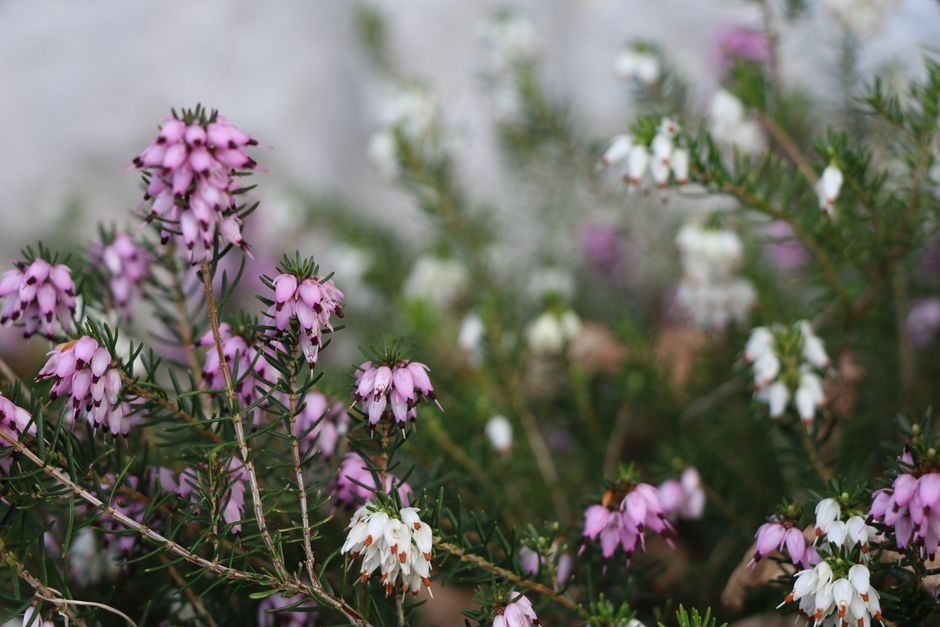
Photo de Rajee sur Unsplash.
De novembre à avril, Erica ouvre le bal
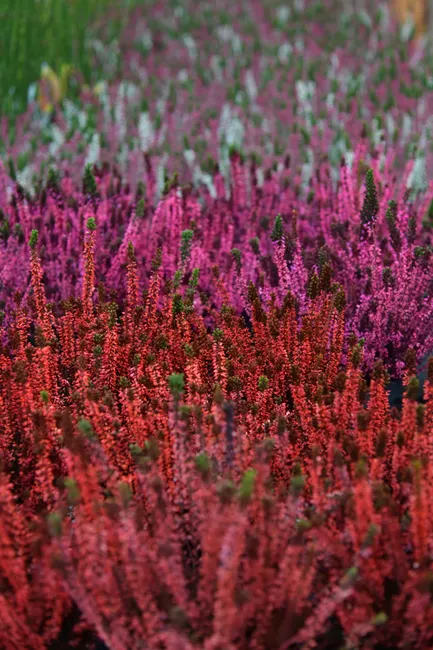
Erica carneala bruyère des Alpes ou bruyère des neiges, fleurit généralement de novembre à avril selon les variétés. Elle forme des coussins bas, accepte une ombre légère et porte des fleurs blanches, roses ou rouges. En pot comme en pleine terre, elle apporte une floraison pendant la période où le massif fait souvent grise mine.
Erica darleyensis prolonge ce relais hivernal jusqu’au printemps. Certaines formes supportent un sol légèrement calcaire, contrairement à de nombreuses bruyères qui préfèrent franchement l’acidité. Ce détail compte : le mot « bruyère » ne suffit pas à connaître les exigences de la plante.
Au printemps, Erica arborea prend de la hauteur avec une floraison blanche, généralement de mars à mai. Sa taille adulte peut atteindre 4 m. Elle demande donc une place de fond ou de transition, pas le premier plan d’une minuscule rocaille. La plante avance avec le calendrier, mais elle peut aussi prendre ses aises.
De juin à l’automne, Calluna prend le relais
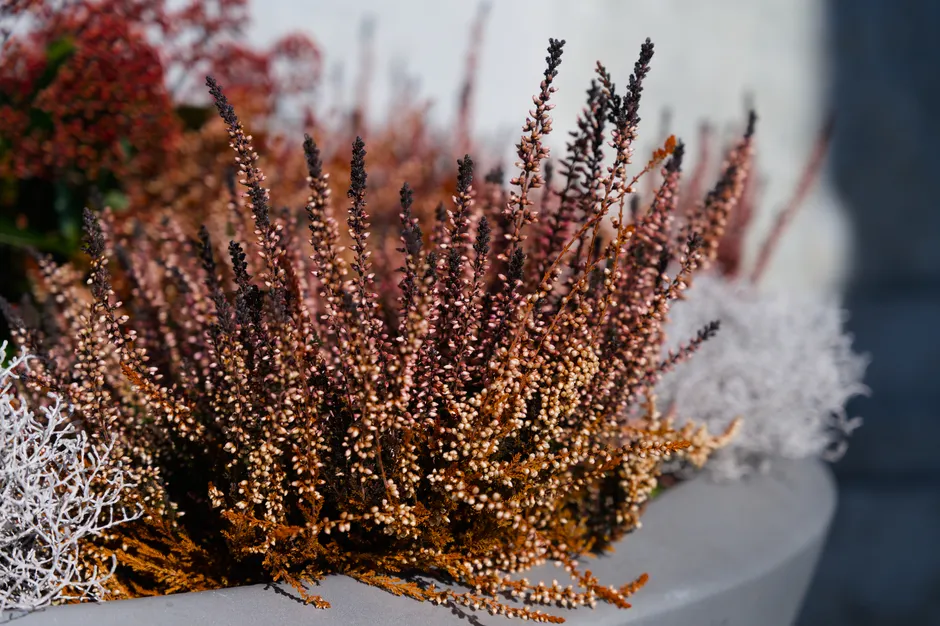
Calluna vulgarisla callune, commence habituellement à fleurir en juin ou en juillet et poursuit sa floraison jusqu’en septembre pour l’espèce type. Certaines variétés prolongent le spectacle jusqu’en novembre ou décembre. Son feuillage persistant reste décoratif en hiver, même lorsque les fleurs ont disparu.
Erica cinerea fleurit en été et complète bien une association avec les callunes. En combinant les bruyères d’hiver, une forme printanière et des callunes estivales, on obtient un relais presque continu. En climat doux, la présence de fleurs peut couvrir les douze mois. Dans une région froide ou très humide, les dates se décalent. La météo, fidèle à son poste, déjoue toujours le calendrier au moment où l’on pensait avoir tout verrouillé.
Sol acide, racines tranquilles
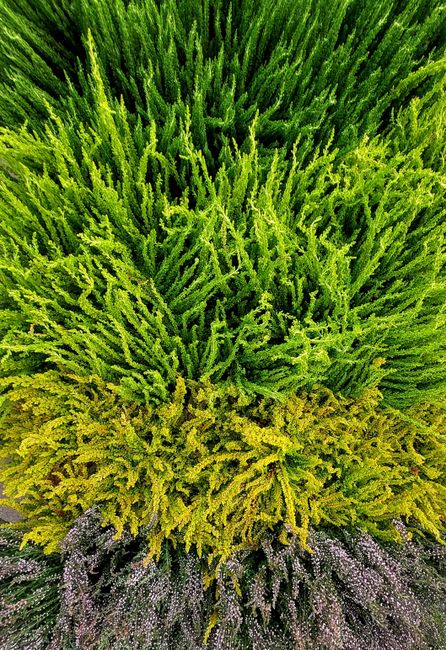
Photo de Guzel Sadykova sur Pexels.
Les bruyères apprécient généralement un sol acide, pauvre, léger et drainant. Elles supportent mal l’eau qui reste bloquée autour des racines. Une terre compacte qui se gorge d’eau en hiver peut donc faire dépérir une plante pourtant réputée facile.
Avant l’achat, vérifiez l’acidité, le drainage et l’exposition. Dans un terrain très calcaire, choisissez une espèce qui tolère un peu de calcaire, comme certaines formes d’Erica carnead’Erica darleyensis ou d’Erica vagans. La culture en pot permet aussi de maîtriser plus facilement le substrat.
L’exposition va du soleil à la mi-ombre. Les callunes fleurissent mieux avec une lumière suffisante, tandis que certaines bruyères d’hiver acceptent une ombre légère. Dans les secteurs très chauds, une ombre légère l’après-midi limite le dessèchement des jeunes plantations.
Les bruyères n’ont pas besoin d’un programme d’engrais régulier. Un apport riche et répété peut favoriser le feuillage au détriment d’un port compact. Un paillage adapté aide surtout à limiter les herbes concurrentes et les variations d’humidité. Le sol, ici, n’a pas besoin d’un buffet à volonté.
Planter sans se faire enfumer par l’étiquette
Photo de Jean-Paul Wettstein sur Pexels.
La plantation en automne ou au début du printemps facilite l’installation, en dehors des périodes de gel ou de sol détrempé. Les sujets en pot peuvent être installés à d’autres moments si l’arrosage reste suivi pendant les premières semaines.
Vérifiez l’acidité, le drainage et l’exposition avant l’achat.
Décompactez la terre sans créer de cuvette qui retiendrait l’eau.
Placez la motte au niveau du sol, tassez légèrement puis arrosez.
Respectez la largeur adulte indiquée pour la variété. Pour les formes basses, un espacement de 30 à 50 cm peut convenir, mais le port final prime sur la règle automatique.
Ajoutez un paillis léger et surveillez l’humidité pendant la reprise.
En pot, choisissez un contenant percé et un substrat acide ou adapté aux plantes de terre de bruyère. Une soucoupe pleine d’eau en permanence transforme rapidement le joli contenant en piège pour les racines. Le drainage passe avant le décor.
Les formes basses conviennent aux rocailles, aux bordures et au premier plan d’un massif. Les formes plus hautes servent plutôt de fond ou de transition avec des arbustes. Mélanger les tailles au hasard donne vite un coussin caché derrière une touffe dominante. Pas franchement joli, ce massif où personne ne voit les fleurs.
Taille douce, pas coupe rase
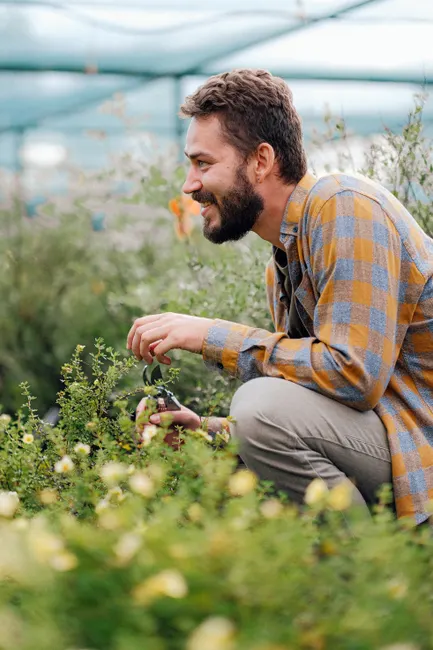
Photo de Anna Shvets sur Pexels.
Après la floraison, retirez les extrémités défleuries pour conserver un port dense. La taille annuelle porte sur les pousses qui ont fleuri. Une coupe sévère dans les parties anciennes risque de laisser des rameaux nus qui repartent mal.
Le calendrier dépend de l’espèce : taillez les floraisons d’hiver au printemps, après leur fin, et les bruyères d’été après leur floraison. Ne rabattez pas toutes les variétés le même week-end sous prétexte que le massif doit être impeccable. La plante ne travaille pas selon l’agenda du dimanche.
L’arrosage reste modéré une fois la plante installée, sauf en cas de sécheresse prolongée. Pendant la première saison, arrosez lorsque la motte sèche en profondeur, puis espacez les apports. L’eau de pluie convient aux espèces acidophiles, notamment dans les secteurs où l’eau du robinet est très calcaire.
Douze mois de fleurs, pas de promesse sous cellophane
Photo de Serena Koi sur Pexels.
Pour choisir une bruyère, regardez le nom botanique, la période de floraison, la hauteur adulte et la tolérance au calcaire. Deux petits pots qui se ressemblent peuvent appartenir à des espèces destinées à des saisons et à des sols différents.
Les bruyères sont aussi des plantes mellifères. Leurs clochettes peuvent fournir du nectar aux insectes actifs pendant les périodes fraîches, lorsque les ressources florales sont moins nombreuses. La floraison d’hiver a donc un intérêt pour le jardin, à condition que les températures permettent aux insectes de sortir.
Le bon massif n’est pas celui qui promet une floraison uniforme toute l’année. C’est celui qui accepte les relais, les décalages et les différences de sol entre les espèces. La bruyère demande peu de soins, mais elle ne négocie pas avec le calcaire, l’eau stagnante ou la mauvaise variété. Le voisin pourra toujours annoncer la prochaine floraison au 15 mars. Le jardin, lui, gardera le dernier mot.
Sources et références scientifiques
Flowering phenology differs among wet and dry sub-alpine meadows in southwestern China – PMC. AoB PLANTS. DOI: 10.1093/aobpla/plae002 · PMID: 38298756.
Ahmad M, Uniyal SK, Batish DR, Rathee S, Sharma P, Singh HP.. 2021. Flower phenological events and duration pattern is influenced by temperature and elevation in Dhauladhar mountain range of Lesser Himalaya. Ecological Indicators 129:107902. [Google Scholar].
Ansquer P, Al Haj Khaled R, Cruz P, Theau JP, Therond O, Duru M.. 2009. Characterizing and predicting plant phenology in species-rich grasslands. Grass and Forage Science 64:57-70. [Google Scholar].
Arroyo MTK, Dudley LS, Jespersen G, Pacheco DA, Cavieres LA.. 2013. Temperature-driven flower longevity in a high-alpine species of Oxalis influences reproductive assurance. The New Phytologist 200:1260-1268. [DOI] [PubMed] [Google Scholar].
Arroyo MTK, Pérez F, Jara P, Pacheco D, Vidal P, Flores MF.. 2019. Ovule bet-hedging at high elevations: evidence from a phylogenetically-controlled multispecies study. Journal of Ecology 107:668-683. [Google Scholar].
Ashman TL, Schoen DJ.. 1994. How long should flowers live? Nature 371:788-791. [Google Scholar].
Ashman TL, Knight TM, Steets JA, Amarasekare P, Burd M, Campbell DR, Dudash MR, Johnston MO, Mazer SJ, Mitchell RJ, et al. 2004. Pollen limitation of plant reproduction: ecological and evolutionary causes and consequences. Ecology 85:2408-2421. [Google Scholar].
Blionis GJ, Halley JM, Vokou D.. 2001. Flowering phenology of Campanula on Mt Olympos, Greece. Ecography 24:696-706. [Google Scholar].
Bosch J, Retana J, Cerda´ X.. 1997. Flowering phenology, floral traits and pollinator composition in a herbaceous Mediterranean plant community. Oecologia 109:583-591. [DOI] [PubMed] [Google Scholar].
CaraDonna PJ, Iler AM, Inouye DW.. 2014. Shifts in flowering phenology reshape a subalpine plant community. Proceedings of the National Academy of Sciences of the United States of America 111:4916-4921. [DOI] [PMC free article] [PubMed] [Google Scholar].
Castro S, Silveira P, Navarro L.. 2008. Effect of pollination on floral longevity and costs ofdelaying fertilization in the out-crossing Polygala vayredae Costa (Polygalaceae). Annals of Botany 102:1043-1048. [DOI] [PMC free article] [PubMed] [Google Scholar].
Catorci A, Carotenuto L, Gatti R.. 2012. Flowering patterns in sub-Mediterranean grasslands: a functional approach. Plant Ecology and Evolution 145:165-175. [Google Scholar].
Cortés-Flores J, Hernández-Esquivel KB, González-Rodríguez A, Ibarra-Manríquez G.. 2017. Flowering phenology, growth forms, and pollination syndromes in tropical dry forest species: Influence of phylogeny and abiotic factors. American Journal of Botany 104:1-11. [DOI] [PubMed] [Google Scholar].
Color polymorphism in Anemone coronaria: Correlations with soil, climate, and flowering phenology – PMC. American journal of botany. DOI: 10.1002/ajb2.70093 · PMID: 40906390.
Arista, M., Talavera M., Berjano R., and Ortiz P. L.. 2013. Abiotic factors may explain the geographical distribution of flower colour morphs and the maintenance of colour polymorphism in the scarlet pimpernel. Journal of Ecology 101: 1613-1622. [Google Scholar].
Berardi, A. E., Fields P. D., Abbate J. L., and Taylor D. R.. 2016. Elevational divergence and clinal variation in floral color and leaf chemistry in Silene vulgaris. American Journal of Botany 103: 1508-1523. [DOI] [PubMed] [Google Scholar].
Bolton, P. E., Rollins L. A., and Griffith S. C.. 2015. The danger within: the role of genetic, behavioural and ecological factors in population persistence of colour polymorphic species. Molecular Ecology 24: 2907-2915. [DOI] [PubMed] [Google Scholar].
Coberly, L. C., and Rausher M. D.. 2003. Analysis of a chalcone synthase mutant in Ipomoea purpurea reveals a novel function for flavonoids: amelioration of heat stress. Molecular Ecology 12: 1113-1124. [DOI] [PubMed] [Google Scholar].
Dafni, A., Tzohari H., Ben‐shlomo R., Vereecken N. J., and Ne'eman G.. 2020. Breeding system and gene flow in Anemone coronaria. Plants 9: 397. [DOI] [PMC free article] [PubMed] [Google Scholar].
Dai, W., Yang Y., Patch H. M., Grozinger C. M., and Mu J.. 2022. Soil moisture affects plant-pollinator interactions in an annual flowering plant. Philosophical Transactions of the Royal Society, B: Biological Sciences 377: 20210423. [DOI] [PMC free article] [PubMed] [Google Scholar].
Dick, C. A., Buenrostro J., Butler T., Carlson M. L., Kliebenstein D. J., and Whittall J. B.. 2011. Arctic mustard flower color polymorphism controlled by petal‐specific downregulation at the threshold of the anthocyanin biosynthetic pathway. PLoS One 6: e18230. [DOI] [PMC free article] [PubMed] [Google Scholar].
Donoso, I., Stefanescu C., Martínez‐Abraín A., and Traveset A.. 2016. Phenological asynchrony in plant-butterfly interactions associated with climate: a community‐wide perspective. Oikos 125: 1434-1444. [Google Scholar].
Gonzalez, A. 2009. Pigment loss in response to the environment: A new role for the WD/bHLH/MYB anthocyanin regulatory complex. New Phytologist 182: 1-3. [DOI] [PubMed] [Google Scholar].
Forsman, A., Ahnesjö J., Caesar S., and Karlsson M.. 2008. A model of ecological and evolutionary consequences of color polymorphism. Ecology 89: 34‐40. [DOI] [PubMed] [Google Scholar].
Horovitz, A. 1976. Edaphic factors and flower colour distribution in the Anemoneae (Ranunculaceae). Plant Systematics and Evolution 126: 239-242. [Google Scholar].
Horovitz, A. 1985. Anemone coronaria and related species. In Halevy A. H. [ed.], Handbook of flowering, 455-464. CRC Press, Boca Raton, FL, USA. [Google Scholar].
Phylogenetic signal in flowering phenology weakens over elevation in the high Andes of Chile: evidence for evolutionary convergence in a harsh habitat – PMC. Frontiers in plant science. DOI: 10.3389/fpls.2026.1738754 · PMID: 41799971.
Ackerly D. D. (2004). Adaptation, niche conservatism, and convergence: comparative studies of leaf evolution in the california chaparral. Am. Nat. 163, 654-671. doi: 10.1086/383062, PMID: [DOI] [PubMed] [Google Scholar]. doi:10.1086/383062.
Ahmad M., Uniyal S. K., Batish D. R., Rathee S., Sharma P., Singh H. P. (2021). Flower phenological events and duration pattern is influenced by temperature and elevation in Dhauladhar mountain range of Lesser Himalaya. Ecol. Indic. 129, 107902. doi: 10.1016/j.ecolind.2021.107902 [DOI] [Google Scholar]. doi:10.1016/j.ecolind.2021.107902.
Arroyo M. T. K., Armesto J. J., Villagran C. (1981). Plant phenological patterns in the high andean cordillera of central Chile. J. Ecol. 69, 205. doi: 10.2307/2259826 [DOI] [Google Scholar]. doi:10.2307/2259826.
Arroyo M. T. K., Robles V., Tamburrino Í., Martínez-Harms J., Garreaud R. D., Jara-Arancio P., et al. (2020). Extreme drought affects visitation and seed set in a plant species in the central Chilean andes heavily dependent on hummingbird pollination. Plants 9, 1553. doi: 10.3390/PLANTS9111553, PMID: [DOI] [PMC free article] [PubMed] [Google Scholar]. doi:10.3390/PLANTS9111553.
Arroyo M. T. K., Tamburrino Í., Pliscoff P., Robles V., Colldecarrera M., Guerrero P. C. (2021). Flowering phenology adjustment and flower longevity in a south american alpine species. Plants 10, 461. doi: 10.3390/plants10030461, PMID: [DOI] [PMC free article] [PubMed] [Google Scholar]. doi:10.3390/plants10030461.
Augspurger C. K. (1983). Phenology, flowering synchrony, and fruit set of six neotropical shrubs. Biotropica 15, 257. doi: 10.2307/2387650 [DOI] [Google Scholar]. doi:10.2307/2387650.
Baeten L., Sercu B., Bonte D., Vanhellemont M., Verheyen K. (2015). Intraspecific variation in flowering phenology affects seed germinability in the forest herb Primula elatior. Plant Ecol. Evol. 148, 283-288. doi: 10.5091/plecevo.2015.1089 [DOI] [Google Scholar]. doi:10.5091/plecevo.2015.1089.
Baraloto C., Hardy O. J., Paine C. E. T., Dexter K. G., Cruaud C., Dunning L. T., et al. (2012). Using functional traits and phylogenetic trees to examine the assembly of tropical tree communities. J. Ecol. 100, 690-701. doi: 10.1111/j.1365-2745.2012.01966.x [DOI] [Google Scholar]. doi:10.1111/j.1365-2745.2012.01966.x.
Basnett S., Nagaraju S. K., Ravikanth G., Devy S. M. (2019). Influence of phylogeny and abiotic factors varies across early and late reproductive phenology of Himalayan Rhododendrons. Ecosphere 10. doi: 10.1002/ecs2.2581 [DOI] [Google Scholar]. doi:10.1002/ecs2.2581.
Bateman R. M., Hilton J., Rudall P. J. (2006). Morphological and molecular phylogenetic context of the angiosperms: contrasting the “top-down” and “bottom-up” approaches used to infer the likely characteristics of the first flowers. J. Exp. Bot. 57, 3471-3503. doi: 10.1093/jxb/erl128, PMID: [DOI] [PubMed] [Google Scholar]. doi:10.1093/jxb/erl128.
Bell C. D., Kutschker A., Arroyo M. T. K. (2012). Phylogeny and diversification of Valerianaceae (Dipsacales) in the southern Andes. Mol. Phylogenet. Evol. 63, 724-737. doi: 10.1016/J.YMPEV.2012.02.015, PMID: [DOI] [PubMed] [Google Scholar]. doi:10.1016/J.YMPEV.2012.02.015.
Blomberg S. P., Garland T. (2002). Tempo and mode in evolution: phylogenetic inertia, adaptation and comparative methods. J. Evol. Biol. 15, 899-910. doi: 10.1046/j.1420-9101.2002.00472.x [DOI] [Google Scholar]. doi:10.1046/j.1420-9101.2002.00472.x.
Delayed flowering phenology of red-flowering plants in response to hummingbird migration – PMC. Current biology : CB. DOI: 10.1016/j.cub.2025.03.035 · PMID: 40233751.
1.Niet T. van der, and Johnson SD (2012). Phylogenetic evidence for pollinator-driven diversification of angiosperms. Trends in Ecology & Evolution 27, 353-361. 10.1016/j.tree.2012.02.002. [DOI] [PubMed] [Google Scholar]. doi:10.1016/j.tree.2012.02.002.
2.Wessinger CA, Rausher MD, and Hileman LC (2019). Adaptation to hummingbird pollination is associated with reduced diversification in Penstemon. Evolution Letters 3, 521-533. 10.1002/evl3.130. [DOI] [PMC free article] [PubMed] [Google Scholar]. doi:10.1002/evl3.130.
3.Johnson SD (2010). The pollination niche and its role in the diversification and maintenance of the southern African flora. Philosophical Transactions of the Royal Society B: Biological Sciences 365, 499-516. 10.1098/rstb.2009.0243. [DOI] [PMC free article] [PubMed] [Google Scholar]. doi:10.1098/rstb.2009.0243.
4.Pellmyr O (1992). Evolution of insect pollination and angiosperm diversification. Trends in Ecology & Evolution 7, 46-49. 10.1016/0169-5347(92)90105-K. [DOI] [PubMed] [Google Scholar]. doi:10.1016/0169-5347(92)90105-K.
5.Fenster CB, Armbruster WS, Wilson P, Dudash MR, and Thomson JD (2004). Pollination Syndromes and Floral Specialization. Annual Review of Ecology, Evolution, and Systematics 35, 375-403. [Google Scholar].
6.Ollerton J, Alarcón R, Waser NM, Price MV, Watts S, Cranmer L, Hingston A, Peter CI, and Rotenberry J (2009). A global test of the pollination syndrome hypothesis. Annals of Botany 103, 1471-1480. 10.1093/aob/mcp031. [DOI] [PMC free article] [PubMed] [Google Scholar]. doi:10.1093/aob/mcp031.
7.Martén-Rodríguez S, Almarales-Castro A, and Fenster CB (2009). Evaluation of pollination syndromes in Antillean Gesneriaceae: evidence for bat, hummingbird and generalized flowers. Journal of Ecology 97, 348-359. 10.1111/j.1365-2745.2008.01465.x. [DOI] [Google Scholar]. doi:10.1111/j.1365-2745.2008.01465.x.
llinger AS (2020). Pollination syndromes in the 21st century: where do we stand and where may we go? New Phytologist 228, 1193-1213. 10.1111/nph.16793. [DOI] [PubMed] [Google Scholar]. doi:10.1111/nph.16793.
9.Willmer P (2011). Pollination and Floral Ecology (Princeton University Press; ). [Google Scholar].
10.Faegri K, and Pijl LVD (2013). Principles of Pollination Ecology (Elsevier; ). [Google Scholar].
11.Vogel S (1954). Blütenbiologische Typen als Elemente der Sippengliederung: dargestellt anhand der Flora Südafrikas (G. Fischer; ). [Google Scholar].
12.van der Pijl L (1960). Ecological Aspects of Flower Evolution. I. Phyletic Evolution. Evolution 14, 403-416. 10.2307/2405990. [DOI] [Google Scholar]. doi:10.2307/2405990.
Bruno Nunez. Bruyères : des variétés en fleurs à chaque saison!. 2024.
Massif de bruyères : comment choisir les variétés pour chaque saison. 2026.
Alexandra. Les bruyères : Planter, tailler et entretenir. 2017.
Bertrand Lambert. Choisir ses bruyères pour avoir des fleurs toute l'année dans son jardin. 2014.
Eric est jardinier passionné depuis 22 ans. Il partage régulièrement ses conseils et astuces de jardinage sur son blog "Jardin-Bio", pour aider les débutants comme les jardiniers confirmés à entretenir et faire évoluer leur jardin.