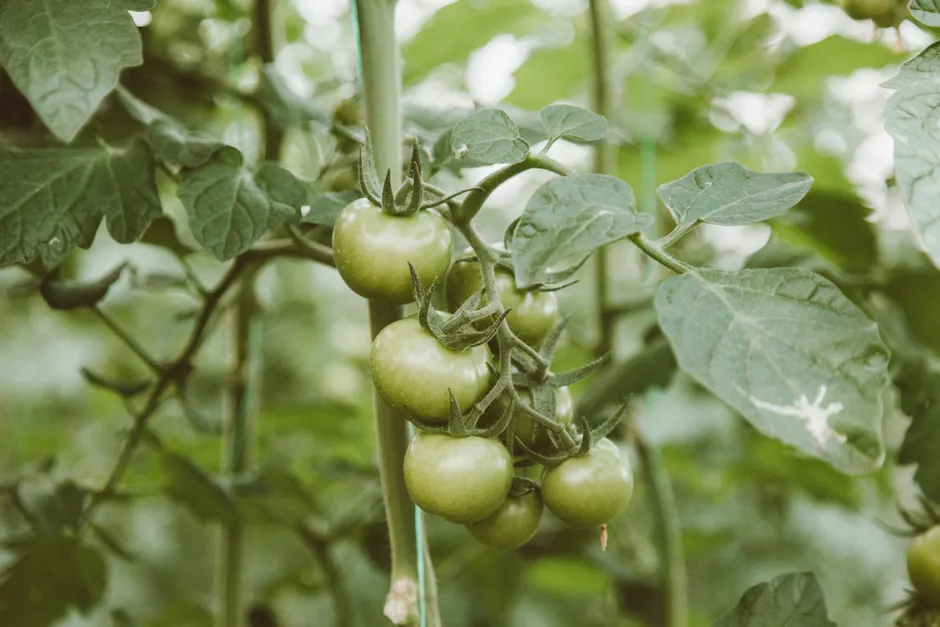
Semée sous abri entre février et avril, plantée après les gelées, la tomate Saint-Pierre peut donner ses premiers fruits dès juin. Son port indéterminé réclame un tuteur solide et son calendrier ne négocie pas avec le froid.
Saint-Pierre, pas sainte-nitouche
Photo de engin akyurt sur Unsplash.
La tomate Saint-Pierre est une variété traditionnelle française cultivée depuis la fin du XIXe siècle. Son port indéterminé signifie que la tige continue de pousser en hauteur pendant la saison. Elle forme généralement des bouquets de quatre à cinq fruits ronds ou légèrement aplatis, à chair ferme.
Les fruits couramment décrits mesurent environ 57 à 67 mm et pèsent de 110 à 120 g. Ces chiffres donnent un repère, pas un contrat signé avec la plante : la souche, le sol, l’eau et la conduite du pied font varier le résultat. Une variété n’est pas une promesse de poids sortie d’une imprimante.
La Saint-Pierre se mange en salade, en tomates farcies, en sauce ou en coulis. Elle accepte différents types de sol et apprécie une exposition au soleil ou à mi-ombre. Dans un potager bio, on associe cette culture au compost mûr, au paillage, à l’observation et aux auxiliaires du jardin.
Le label AB relève d’un cadre de production et de certification. Une tomate cultivée dans un jardin familial avec des pratiques biologiques ne devient donc pas automatiquement une tomate labellisée AB. La nuance paraît administrative, mais elle évite de faire dire au mot « bio » ce qu’il ne dit pas.
Février sème, mai plante
Photo de Taylor Thompson sur Pexels.
Le semis se réalise de février à avril sous abri. Les graines ont besoin d’une température d’au moins 20 °C pour germer. Trop tôt derrière une fenêtre froide et peu lumineuse, le plant file, pâlit et devient fragile. Dans les régions fraîches, mieux vaut parfois semer plus tard que rater en beauté son départ.
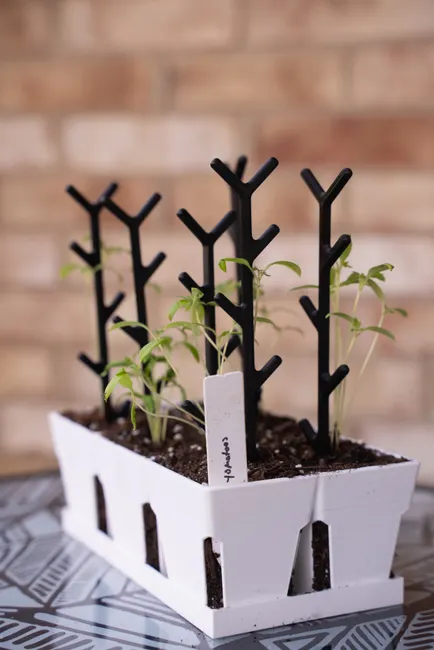
Semez sous abri dans un mélange de terre de jardin et de terreau de semis. Placez les graines à environ 1 cm de profondeur, puis humidifiez sans détremper.
Attendez la levéequi intervient souvent au bout d’une semaine lorsque la température reste stable. Installez ensuite les jeunes plants dans un endroit lumineux.
Repiquez au bon stade lorsque les plants atteignent environ 15 cm. La transplantation en pleine terre intervient après les dernières gelées.
Préparez le support avant de planter. Gardez environ 40 cm entre les pieds et 70 cm entre les rangs pour laisser circuler l’air et intervenir autour des plants.
En climat tempéré, la plantation se situe souvent vers la mi-mai. Dans une parcelle froide ou exposée aux gelées tardives, elle peut attendre davantage. Un plant de tomate ne consulte pas le calendrier avant de grelotter.
Le sol fait loi, le tuteur aussi
Photo de cottonbro studio sur Pexels.
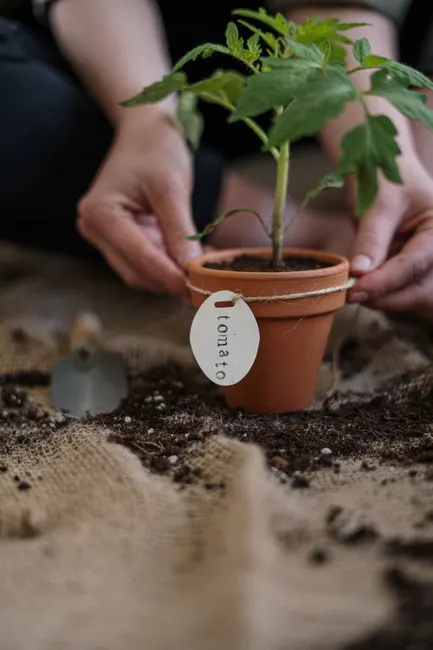
À la plantation, creusez un trou d’environ 20 cm et installez le pied légèrement en biais. Enterrez la base de la tige jusqu’aux premières feuilles, après avoir retiré celles qui se retrouveraient sous terre. La partie enfouie peut produire de nouvelles racines.
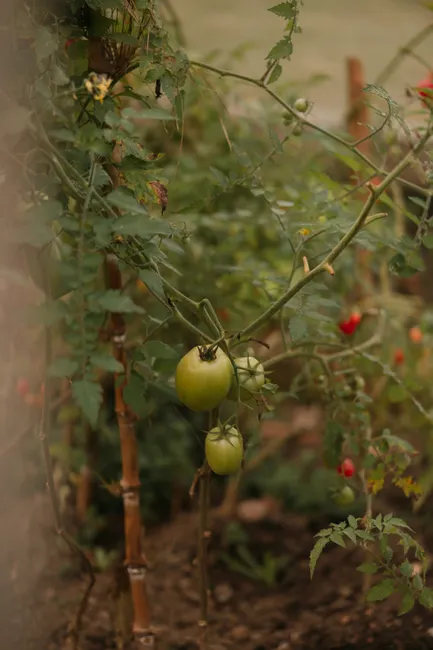
Le tuteur se place avant ou au moment de la plantation. Une tomate à port indéterminé finit par peser sur ses attaches et ses bouquets : un support installé trop tard risque d’abîmer les racines et de transformer le palissage en chirurgie du dimanche.
Le compost mûr s’intègre au travail du sol, tandis que le paillage aide à conserver l’humidité. Gardez toutefois une zone dégagée autour de la tige. Le paillage ne remplace ni l’observation ni l’arrosage, malgré les slogans qui voudraient lui confier les clés du potager.
Gourmands, mildiou : ça négocie sévère
Photo de Alexander Mass sur Pexels.
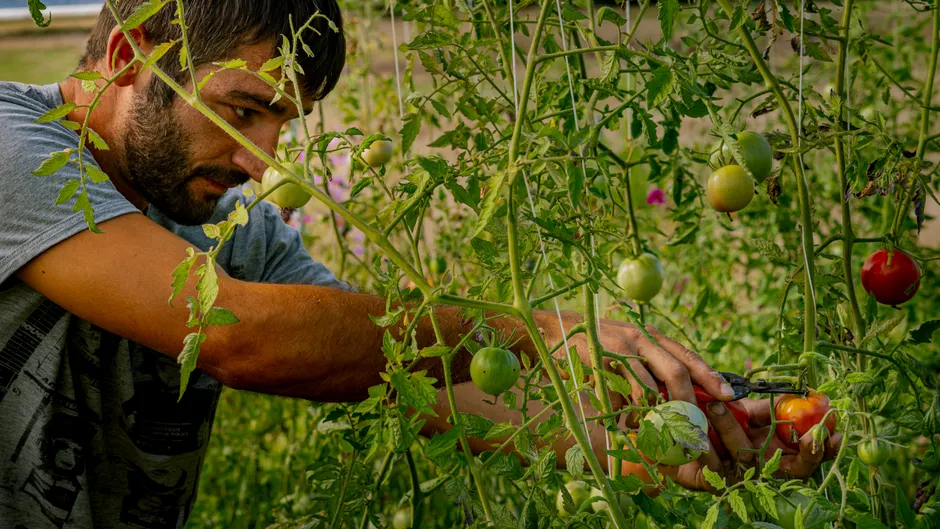
La suppression des gourmands est une option de conduite. Elle consiste à retirer les pousses qui apparaissent à l’aisselle des feuilles afin de privilégier la tige principale. Cette pratique peut favoriser des fruits plus gros, mais elle ne transforme pas chaque pied en usine à tomates. La taille reste un choix, pas un bouton magique à rendement.
Comme presque toutes les tomates, la Saint-Pierre peut être touchée par le mildiou. Arrosez au pied plutôt que sur le feuillage, surveillez l’état des feuilles et évitez de maintenir la plante humide sans nécessité. En cas de problème, retirez les parties atteintes avec des outils propres et ne laissez pas les débris malades au contact des plants.
Chaleur en hausse, maturité en pause
Photo de ROMAN ODINTSOV sur Pexels.
La chaleur ne garantit ni une nouaison régulière ni un mûrissement rapide. Une étude publiée en 2023 dans Frontiers in Plant Science a suivi la variété Savior, décrite comme tolérante à la chaleur, au Vietnam. En été, le pic de production d’éthylène arrivait au stade rouge mûr, plus tard qu’en saison hivernale. L’étude est consultable via son DOI.
Ce résultat porte sur Savior, pas sur la Saint-Pierre. Il ne permet donc pas d’attribuer à cette dernière une tolérance particulière aux fortes températures. Il rappelle cependant une limite du conseil généraliste : pailler et arroser ne suffisent pas toujours lorsque la chaleur perturbe la maturation. La météo, elle, ne lit pas les fiches variétales.
Récolte en fanfare, assiette sans cinéma
Photo de Valentina Ivanova sur Unsplash.
Les premières tomates arrivent généralement quatre à cinq mois après le semis. Selon les conditions, la récolte s’étend de juin à septembre et peut se prolonger jusqu’en octobre dans les climats favorables. Après la plantation en place, les fruits mûrissent souvent en 70 à 80 jours, mais la température et l’exposition déplacent ce repère.
Cueillez les fruits lorsqu’ils sont rouges et fermes. Les bouquets de quatre à cinq tomates permettent une récolte progressive, au fur et à mesure de la maturité. La chair ferme convient aux tranches, aux salades, aux tomates farcies, aux sauces et aux coulis.
Une tomate légèrement abîmée se cuisine rapidement au lieu d’attendre au fond d’une cagette jusqu’à devenir une expérience scientifique. Et si la Saint-Pierre déborde du tuteur, le voisin aura sûrement une solution contradictoire. La plante, elle, gardera le dernier mot.
Sources et références scientifiques
Efficient regeneration of protoplasts from Solanum lycopersicum cultivar Micro-Tom – PMC. Biology methods & protocols. DOI: 10.1093/biomethods/bpae008 · PMID: 38414647.
1. Ikeuchi M, Favero DS, Sakamoto Y. et al. Molecular mechanisms of plant regeneration. Annu Rev Plant Biol 2019;70:377-406. [DOI] [PubMed] [Google Scholar].
2. Roest S, Gilissen LJW.. Plant-regeneration from protoplasts, a literature-review. Acta Bot Neerl 1989;38:1-23. [Google Scholar].
3. Jeong YY, Lee H-Y, Kim SW. et al. Optimization of protoplast regeneration in the model plant Arabidopsis thaliana. Plant Methods 2021;17:21.16. [DOI] [PMC free article] [PubMed] [Google Scholar].
4. Kiełkowska A, Adamus A.. An alginate-layer technique for culture of Brassica oleracea L. protoplasts. In Vitro Cell Dev Biol Plant 2012;48:265-73. [DOI] [PMC free article] [PubMed] [Google Scholar].
5. Grzebelus E, Szklarczyk M, Baranski R.. An improved protocol for plant regeneration from leaf- and hypocotyl-derived protoplasts of carrot. Plant Cell Tiss Organ Cult 2012;109:101-9. [Google Scholar].
6. Barceló M, Wallin A, Medina JJ. et al. Isolation and culture of strawberry protoplasts and field evaluation of regenerated plants. Sci Hortic-Amsterdam 2019;256:108552. [Google Scholar].
7. Damm B, Willmitzer L.. Regeneration of fertile plants from protoplasts of different Arabidopsis thaliana genotypes. Molec Gen Genet 1988;213:15-20. [Google Scholar].
9. Lin CS, Hsu CT, Yang LH. et al. Application of protoplast technology to CRISPR/Cas9 mutagenesis: from single-cell mutation detection to mutant plant regeneration. Plant Biotechnol J 2018;16:1295-310. [DOI] [PMC free article] [PubMed] [Google Scholar].
10. Andreasson E, Kieu NP, Zahid MA. et al. Invited Mini-Review Research Topic: utilization of Protoplasts to Facilitate Gene Editing in Plants: schemes for Shoot Regeneration From Tissues and Protoplasts of Potato and Rapeseed: implications of Bioengineering Such as Gene Editing of Broad-Leaved Plants. Front Genome Ed 2022;4:780004. [DOI] [PMC free article] [PubMed] [Google Scholar].
11. Woo JW, Kim J, Kwon SI. et al. DNA-free genome editing in plants with preassembled CRISPR-Cas9 ribonucleoproteins. Nat Biotechnol 2015;33:1162-4. [DOI] [PubMed] [Google Scholar].
12. Lin CS, Hsu CT, Yuan YH. et al. DNA-free CRISPR-Cas9 gene editing of wild tetraploid tomato using protoplast regeneration. Plant Physiol 2022;188:1917-30. [DOI] [PMC free article] [PubMed] [Google Scholar].
A telomere-to-telomere reference genome assembly of tomato cultivar ‘Heinz 1706’ – PMC. Plant communications. DOI: 10.1016/j.xplc.2025.101618 · PMID: 41261773.
Chang S.B., Yang T.J., Datema E., van Vugt J., Vosman B., Kuipers A., Meznikova M., Szinay D., Lankhorst R.K., Jacobsen E., de Jong H. FISH mapping and molecular organization of the major repetitive sequences of tomato. Chromosome Res. 2008;16:919-933. doi: 10.1007/s10577-008-1249-z. [DOI] [PubMed] [Google Scholar]. doi:10.1007/s10577-008-1249-z.
Chen W., Yan M., Chen S., Sun J., Wang J., Meng D., Li J., Zhang L., Guo L. The complete genome assembly of Nicotiana benthamiana reveals the genetic and epigenetic landscape of centromeres. Nat. Plants. 2024;10:1928-1943. doi: 10.1038/s41477-024-01849-y. [DOI] [PubMed] [Google Scholar]. doi:10.1038/s41477-024-01849-y.
Cheng H., Asri M., Lucas J., Koren S., Li H. Scalable telomere-to-telomere assembly for diploid and polyploid genomes with double graph. Nat. Methods. 2024;21:967-970. doi: 10.1038/s41592-024-02269-8. [DOI] [PMC free article] [PubMed] [Google Scholar]. doi:10.1038/s41592-024-02269-8.
Francastel C., Magdinier F. DNA methylation in satellite repeats disorders. Essays Biochem. 2019;63:757-771. doi: 10.1042/EBC20190028. [DOI] [PubMed] [Google Scholar]. doi:10.1042/EBC20190028.
Henderson I.R., Jacobsen S.E. Tandem repeats upstream of the Arabidopsis endogene SDC recruit non-CG DNA methylation and initiate siRNA spreading. Genes Dev. 2008;22:1597-1606. doi: 10.1101/gad.1667808. [DOI] [PMC free article] [PubMed] [Google Scholar]. doi:10.1101/gad.1667808.
Rautiainen M., Nurk S., Walenz B.P., Logsdon G.A., Porubsky D., Rhie A., Eichler E.E., Phillippy A.M., Koren S. Telomere-to-telomere assembly of diploid chromosomes with Verkko. Nat. Biotechnol. 2023;41:1474-1482. doi: 10.1038/s41587-023-01662-6. [DOI] [PMC free article] [PubMed] [Google Scholar]. doi:10.1038/s41587-023-01662-6.
Tomato Genome Consortium The tomato genome sequence provides insights into fleshy fruit evolution. Nature. 2012;485:635-641. doi: 10.1038/nature11119. [DOI] [PMC free article] [PubMed] [Google Scholar]. doi:10.1038/nature11119.
Woo H.R., Richards E.J. Natural variation in DNA methylation in ribosomal RNA genes of Arabidopsis thaliana. BMC Plant Biol. 2008;8:92. doi: 10.1186/1471-2229-8-92. [DOI] [PMC free article] [PubMed] [Google Scholar]. doi:10.1186/1471-2229-8-92.
Zhang H., Lang Z., Zhu J.K. Dynamics and function of DNA methylation in plants. Nat. Rev. Mol. Cell Biol. 2018;19:489-506. doi: 10.1038/s41580-018-0016-z. [DOI] [PubMed] [Google Scholar]. doi:10.1038/s41580-018-0016-z.
Zhou Y., Zhang Z., Bao Z., Li H., Lyu Y., Zan Y., Wu Y., Cheng L., Fang Y., Wu K., et al. Graph pangenome captures missing heritability and empowers tomato breeding. Nature. 2022;606:527-534. doi: 10.1038/s41586-022-04808-9. [DOI] [PMC free article] [PubMed] [Google Scholar]. doi:10.1038/s41586-022-04808-9.
Alonge M, Soyk S, Ramakrishnan S, Wang X, Goodwin S, Sedlazeck FJ, Lippman ZB, Schatz MC (2019) RaGOO: Fast and accurate reference-guided scaffolding of draft genomes. Genome Biol 20: 224. [DOI] [PMC free article] [PubMed] [Google Scholar].
Aoki K, Yano K, Suzuki A, Kawamura S, Sakurai N, Suda K, Kurabayashi A, Suzuki T, Tsugane T, Watanabe M, et al. (2010) Large-scale analysis of full-length cDNAs from the tomato (Solanum lycopersicum) cultivar Micro-Tom, a reference system for the Solanaceae genomics. BMC Genomics 11: 210. [DOI] [PMC free article] [PubMed] [Google Scholar].
Ariizumi T, Aoki K, Ezura H (2011) Systematic development of tomato BioResources in Japan. Interdiscip Bio Cent 3: 1.1-1.6 [Google Scholar].
Asamizu E, Shirasawa K, Hirakawa H, Sato S, Tabata S, Yano K, Ariizumi T, Shibata D, Ezura H (2012) Mapping of Micro-Tom BAC-end sequences to the reference tomato genome reveals possible genome rearrangements and polymorphisms. Int J Plant Genomics 2012: 437026. [DOI] [PMC free article] [PubMed] [Google Scholar].
Bae S-H, Park J, Park SJ, Han J, Oh J-H (2021) Transcriptome data for tissue-specific genes in four reproductive organs at three developmental stages of Micro-Tom tomato. Data Brief 34: 106715. [DOI] [PMC free article] [PubMed] [Google Scholar].
Buchfink B, Reuter K, Drost H-G (2021) Sensitive protein alignments at tree-of-life scale using DIAMOND. Nat Methods 18: 366-368 [DOI] [PMC free article] [PubMed] [Google Scholar].
Cabanettes F, Klopp C (2018) D-GENIES: Dot plot large genomes in an interactive, efficient and simple way. PeerJ 6: e4958. [DOI] [PMC free article] [PubMed] [Google Scholar].
Cantalapiedra CP, Hernández-Plaza A, Letunic I, Bork P, Huerta-Cepas J (2021) eggNOG-mapper v2: Functional annotation, orthology assignments, and domain prediction at the metagenomic scale. Mol Biol Evol 38: 5825-5829 [DOI] [PMC free article] [PubMed] [Google Scholar].
Carvalho RF, Campos ML, Pino LE, Crestana SL, Zsogon A, Lima JE, Benedito VA, Peres LE (2011) Convergence of developmental mutants into a single tomato model system: “Micro-Tom” as an effective toolkit for plant development research. Plant Methods 7: 18. [DOI] [PMC free article] [PubMed] [Google Scholar].
Cheng H, Concepcion GT, Feng X, Zhang H, Li H (2021) Haplotype-resolved de novo assembly using phased assembly graphs with hifiasm. Nat Methods 18: 170-175 [DOI] [PMC free article] [PubMed] [Google Scholar].
Cingolani P, Platts A, Wang LL, Coon M, Nguyen T, Wang K, Land SJ, Lu X, Ruden DM (2012) A program for annotating and predicting the effects of single nucleotide polymorphisms, SnpEff: SNPs in the genome of Drosophila melanogaster strain w1118; iso-2; iso-3. Fly (Austin) 6: 80-92 [DOI] [PMC free article] [PubMed] [Google Scholar].
Cong B, Barrero LS, Tanksley SD (2008) Regulatory change in YABBY-like transcription factor led to evolution of extreme fruit size during tomato domestication. Nat Genet 40: 800-804 [DOI] [PubMed] [Google Scholar].
Targeted system approach to ethylene biosynthesis and signaling of a heat tolerant tomato cultivar; the impact of growing season on fruit ripening – PMC. Frontiers in plant science. DOI: 10.3389/fpls.2023.1195020 · PMID: 37457344.
Adams D. O., Yang S. F. (1979). Ethylene biosynthesis: identification of 1-Aminocyclopropane-1-Carboxylic acid as an intermediate in the conversion of methionine to ethylene. Proc. Natl. Acad. Sci. 76 (1), 170-174. doi: 10.1073/pnas.76.1.170 [DOI] [PMC free article] [PubMed] [Google Scholar]. doi:10.1073/pnas.76.1.170.
Alam M. S., Sultana N., Ahmad S., Hossain M. M., Islam A. K. M. A. (1970). Performance of heat tolerant tomato hybrid lines under hot, humid conditions. Bangladesh J. Agric. Res. 35 (3), 367-373. doi: 10.3329/bjar.v35i3.6442 [DOI] [Google Scholar]. doi:10.3329/bjar.v35i3.6442.
Antunes M. D. C., Sfakiotakis E. M. (2000). Effect of high temperature stress on ethylene biosynthesis, respiration and ripening of ‘Hayward’ kiwifruit. Postharvest Biol. Technol. 20 (3), 251-259. doi: 10.1016/S0925-5214(00)00136-8 [DOI] [Google Scholar]. doi:10.1016/S0925-5214(00)00136-8.
Barrett D. M., Beaulieu J. C., Shewfelt. R. (2010). Color, flavor, texture, and nutritional quality of fresh-cut fruits and vegetables: desirable levels, instrumental and sensory measurement, and the effects of processing. Crit. Rev. Food Sci. Nutr. 50 (5), 369-895. doi: 10.1080/10408391003626322 [DOI] [PubMed] [Google Scholar]. doi:10.1080/10408391003626322.
Bateman A. (2019). UniProt: a worldwide hub of protein knowledge. Nucleic Acids Res. 47 (D1), D506-D515. doi: 10.1093/nar/gky1049 [DOI] [PMC free article] [PubMed] [Google Scholar]. doi:10.1093/nar/gky1049.
Biggs M.S., Handa A. K. (1988). Biochemical basis of high-temperature inhibition of ethylene biosynthesis in ripening tomato fruits. Physiologia Plantarum 72 (3), 572-785. doi: 10.1111/J.1399-3054.1988.TB09167.X [DOI] [Google Scholar]. doi:10.1111/J.1399-3054.1988.TB09167.X.
Binder B. M. (2020). Ethylene signaling in plants. J. Biol. Chem. 295 (22), 7710-7725. doi: 10.1074/jbc.REV120.010854 [DOI] [PMC free article] [PubMed] [Google Scholar]. doi:10.1074/jbc.REV120.010854.
Brandt Sára, Pék Zoltán, Barna Éva, Lugasi A., Lajos H. (2006). Lycopene content and colour of ripening tomatoes as affected by environmental conditions. J. Sci. Food Agric. 86 (4), 568-725. doi: 10.1002/JSFA.2390 [DOI] [Google Scholar]. doi:10.1002/JSFA.2390.
Bulens I., de Poel B. V., Maarten L. A. T. M., Hertog M. P., Proft De, Geeraerd A. H., et al. (2011). Protocol: an updated integrated methodology for analysis of metabolites and enzyme activities of ethylene biosynthesis. Plant Methods 7 (1), 175. doi: 10.1186/1746-4811-7-17 [DOI] [PMC free article] [PubMed] [Google Scholar]. doi:10.1186/1746-4811-7-17.
Camejo D., Rodríguez P., Morales Ma A., Dell’Amico JoséM., Torrecillas A., Alarcón J. José. (2005). High temperature effects on photosynthetic activity of two tomato cultivars with different heat susceptibility. J. Plant Physiol. 162 (3), 281-895. doi: 10.1016/j.jplph.2004.07.014 [DOI] [PubMed] [Google Scholar]. doi:10.1016/j.jplph.2004.07.014.
Cantwell M. (2010). “Optimum procedures for ripening tomatoes,” in Fruit ripening and ethylene management, postharvest horticulture series (Davis, California: University of California; ), 9, 106-116. [Google Scholar].
Chen Yi, Grimplet Jérôme, David K., Castellarin S. D., Terol J., Wong D. C. J., et al. (2018). Ethylene receptors and related proteins in climacteric and non-climacteric fruits. Plant Sci. 276, 63-72. doi: 10.1016/j.plantsci.2018.07.012 [DOI] [PubMed] [Google Scholar]. doi:10.1016/j.plantsci.2018.07.012.
Bruno Nunez. La Tomate Saint Pierre : Le bon goût d’une valeur sûre!. 2023.
Christophe Dutertre. Tomate ‘Saint Pierre’ : nos conseils pour bien la cultiver. 2020.
Alain. Tomate Saint-Pierre : fiche variétale et conseils de culture. 2026.
Jean. Tomate Saint Pierre : Variété Ancienne, Productive Et Savoureuse. 2026.
Eric est jardinier passionné depuis 22 ans. Il partage régulièrement ses conseils et astuces de jardinage sur son blog "Jardin-Bio", pour aider les débutants comme les jardiniers confirmés à entretenir et faire évoluer leur jardin.